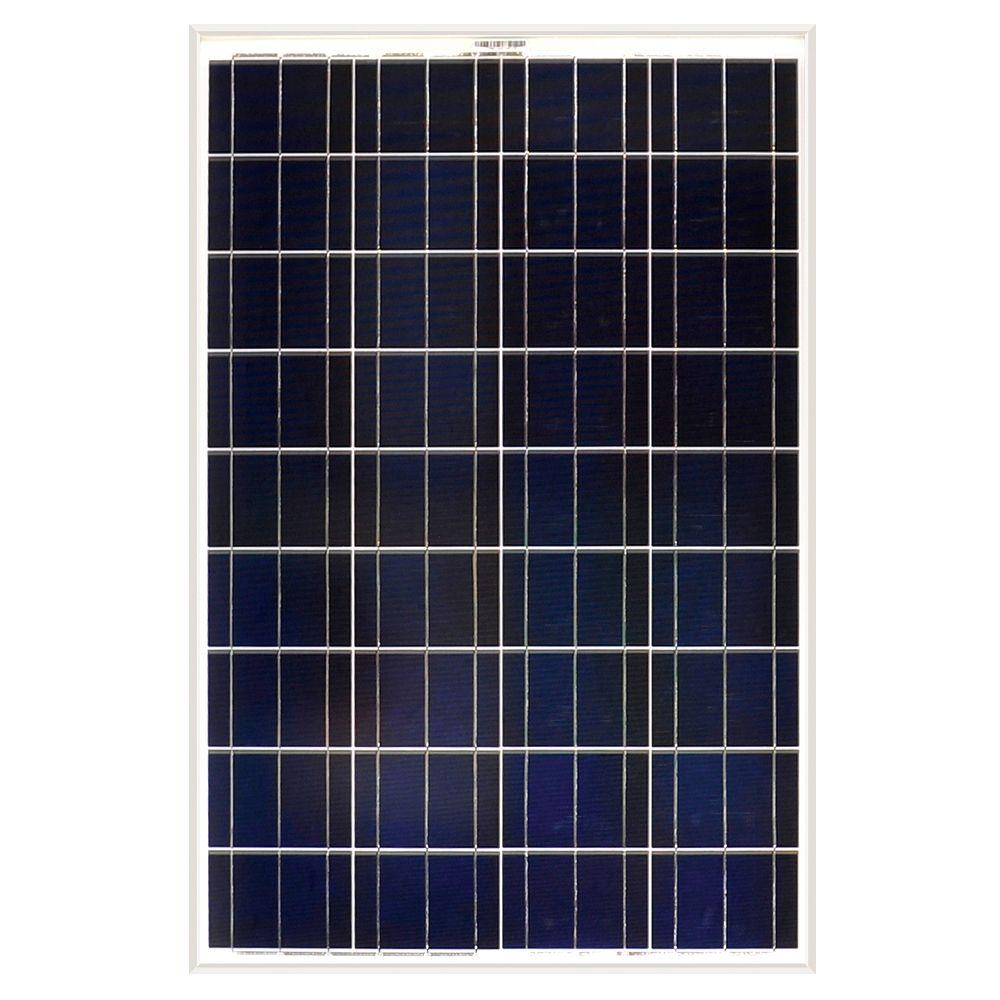
Grape Solar 100-Watt 12-Volt Polycrystalline Solar Panel $99 + Free Shipping
$99.00
$145.49
+11Deal Score
14,503 Views
Home Depot[homedepot.com] has Grape Solar 100-Watt 12-Volt Polycrystalline Solar Panel on sale for $99. Shipping is free, alternatively, store pickup is free.
This is almost as good as previous deal from about a month ago ($89 for 100W panel) which is still great if you missed out on these.
I've been watching these for a few weeks. I bought 2 from Amazon a couple weeks back for $115 and wanted 2 more, but price jumped to over $170! Got this notice from HD a couple days ago, so bought 2 more and had the other 2 price matched! Should have my 2 from HD delivered in Tuesday!
What's the difference between this and the Polycrystalline panels on eBay and Amazon that also sell for $100-107? This has a 5 year warranty and the one luckygecko linked to has a "25 year transferable power output warranty" yet you downvote his/her post.
What accessories do you need to convert this regular 12v outlet? Can you charge Poe cameras and hybrid cars?
Quote
from slickska
:
I like to know also
[One 100 watt / 8 Amp panel would not make much of a dent in charging a car. An AC Level 1 charger is 120v and 16amps, thus at 12V it would take 160amps (the conversion is not fully direct because some power is lost), but 160amps is 20 of these 100 Watt panels. ]
At the least, you will need a 12V deep-cycle battery, a solar/charger controller of at least 10Amps (this solar panel is 8.3 Amps, waterproof if it is outdoors), the mounts for the solar panel, and the wiring to hook them up. I paid $130 for everything but the battery the other day at Amazon. [If the camera has it's own battery, and supports 12v, you would not need the battery of course.]
Your battery needs to be large enough to power the camera for the time the sun is not running the panel, say 16 hours. So, take a look at what you want to power and see if the battery has an amp hour rating that will work. If you need to power a 12V two-amp (hypothetical) item, then at the min the battery would need to be rated at 32 Amp Hours (16 X 2), but in this case you would want reserve for cloudy days, etc. Likewise, the solar panel needs to be able to power the item during the day (2 Amps in this example) and recharge the battery. Under the best conditions this OP panel generates a little over 8 AMPs, so subtract 2 amps for the powered item, that leaves 6 amps to charge the battery. So, it could recharge the battery in about 5 1/2 hours, but these are all ideal, no clouds, no heat loss (the system is less effective in the heat), etc.
Quote
from valve5
:
What's the difference between this and the Polycrystalline panels on eBay and Amazon that also sell for $100-107? This has a 5 year warranty and the one luckygecko linked to has a "25 year transferable power output warranty" yet you downvote his/her post.
That was my point. I was hoping someone could point out the reason to go with this 'Grape' one over others. [Although, I don't think some random Chinese company will be around in 25 years.] I don't care if they down vote me or not, I try to provide useful information and questions.
[Although, I find it a joke when SD staff says things make it to the Front Page based on votes. This posting had 4 votes when it went FP. As a general rule, things that make the front page quickly are items that will generate referral revenue. For example, even if one does not buy this item, places track the referral thus reward SD even the the person buys something else. It does not bother me either, for I know that and still come here; yet the standards of this site has went way down hill over the past year or so. ]
Depends what you're trying to do/power. Usually you'll also need a charge controller if you're planning on storing the power in batteries, and/or powering from the batteries. If you're new to solar stuff there's some good starter kits by Renology (as others have pointed out) that come with basically all you need (are a bit more expensive) but will get you started in learning about solar power/circuits etc.
Checkout the previous thread for these panels, especially user Penguina's posts. IMO For these kinda of panels you really want to avoid having an inverter to get 120VAC out of them... it's just not cost efficient (besides all the other needed equipment being expensive).
These 100Watt panels are best used to power "mobile" or "off-grid" small applications, or 12 volt devices (i.e fans, lights, etc). For example, I am planning to use these to ventilate my attic using high-output PC fans, not using batteries but just direct connection to buck converters since I just need ventilation when the sun is out making my attic hot.
Depends what you're trying to do/power. Usually you'll also need a charge controller if you're planning on storing the power in batteries, and/or powering from the batteries. If you're new to solar stuff there's some good starter kits by Renology (as others have pointed out) that come with basically all you need (are a bit more expensive) but will get you started in learning about solar power/circuits etc.
Checkout the previous thread for these panels, especially user Penguina's posts. IMO For these kinda of panels you really want to avoid having an inverter to get 120VAC out of them... it's just not cost efficient (besides all the other needed equipment being expensive).
These 100Watt panels are best used to power "mobile" or "off-grid" small applications, or 12 volt devices (i.e fans, lights, etc). For example, I am planning to use these to ventilate my attic using high-output PC fans, not using batteries but just direct connection to buck converters since I just need ventilation when the sun is out making my attic hot.
Curious how much energy you expect to save doing this? I can't imagine it would improve your cooling by more than 10%. My electric bill is only $100-150 in the summer (usually about 80-90 degrees here) with keeping the a/c at anywhere between 71 and 75. And only part of that $150 is due to the a/c, maybe $60 tops. Even at 10% more efficiency that's only saving like $6/month 5 months out of the year in my climate.
Curious how much energy you expect to save doing this? I can't imagine it would improve your cooling by more than 10%. My electric bill is only $100-150 in the summer (usually about 80-90 degrees here) with keeping the a/c at anywhere between 71 and 75. And only part of that $150 is due to the a/c, maybe $60 tops. Even at 10% more efficiency that's only saving like $6/month 5 months out of the year in my climate.
The question is: How well can you ventilate an attic using pc fans? Even larger ones like the 24 volt server fans?
Umm, I think the 10% you gave is generous. Not to mention, when you use these with fans you must generate A Lot more solar amps than the fan uses just to allow it to start up. I've worked with this start up issue before with solar heaters.
I'd be more inclined to go passive turbines, radiant barrier and soffet venting for an attic rather than active solar. I'm a solar user, but active rarely makes sense unless it's the only solution. My solar is for backup.
But if you have it mainly for backup, nothing wrong with using the excess. Just didn't seem like this guy's plan.
Curious how much energy you expect to save doing this? ... only saving like $6/month 5 months out of the year in my climate.
I live in Georgia, so it's pretty hot for a lot of the year. And my attic gets stupid hot, especially in the summer... so anything that improves ventilation is gonna be a plus for me, especially since my upstairs A/C unit is in the attic. Getting basically "free" power from a 100W panel to help ventilate the attic will likely extend the life of the shingles, and (I think) help the A/C unit be more efficient. I think this will pay for itself in a few years, if not maybe just in the extra life of the shingles. Haven't run the numbers, but doing this little solar project is also a learning opportunity for me so I don't mind the $100 or so bucks I'm throwing at it.
I do plan on checking out some radiant barrier as well, but maybe I'll tackle that next summer.
I live in Georgia, so it's pretty hot for a lot of the year. And my attic gets stupid hot, especially in the summer... so anything that improves ventilation is gonna be a plus for me, especially since my upstairs A/C unit is in the attic. Getting basically "free" power from a 100W panel to help ventilate the attic will likely extend the life of the shingles, and (I think) help the A/C unit be more efficient. I think this will pay for itself in a few years, if not maybe just in the extra life of the shingles. Haven't run the numbers, but doing this little solar project is also a learning opportunity for me so I don't mind the $100 or so bucks I'm throwing at it.
I do plan on checking out some radiant barrier as well, but maybe I'll tackle that next summer.
It sounds to me like you even have power in the attic that is easy to access, so why go solar? The power 'savings' you will see from solar will probably never offset the cost of the system or the effort to install it. Just wire a fan into your attic on a thermal switch!
Unless this is a fun hobby, then go nuts and enjoy.


22 Comments
Your comment cannot be blank.
Sign up for a Slickdeals account to remove this ad.
This is almost as good as previous deal from about a month ago ($89 for 100W panel) which is still great if you missed out on these.
A 12% price increase is not almost as good.
Likewise, how is this different than all the other $99 100-watt panels? Such as this one: https://www.amazon.com/Newpowa-Po...B00L6LZRXM
I like to know also
Sign up for a Slickdeals account to remove this ad.
https://www.amazon.com/dp/B00BFCN...EHYP4
At the least, you will need a 12V deep-cycle battery, a solar/charger controller of at least 10Amps (this solar panel is 8.3 Amps, waterproof if it is outdoors), the mounts for the solar panel, and the wiring to hook them up. I paid $130 for everything but the battery the other day at Amazon. [If the camera has it's own battery, and supports 12v, you would not need the battery of course.]
Your battery needs to be large enough to power the camera for the time the sun is not running the panel, say 16 hours. So, take a look at what you want to power and see if the battery has an amp hour rating that will work. If you need to power a 12V two-amp (hypothetical) item, then at the min the battery would need to be rated at 32 Amp Hours (16 X 2), but in this case you would want reserve for cloudy days, etc. Likewise, the solar panel needs to be able to power the item during the day (2 Amps in this example) and recharge the battery. Under the best conditions this OP panel generates a little over 8 AMPs, so subtract 2 amps for the powered item, that leaves 6 amps to charge the battery. So, it could recharge the battery in about 5 1/2 hours, but these are all ideal, no clouds, no heat loss (the system is less effective in the heat), etc.
[Although, I find it a joke when SD staff says things make it to the Front Page based on votes. This posting had 4 votes when it went FP. As a general rule, things that make the front page quickly are items that will generate referral revenue. For example, even if one does not buy this item, places track the referral thus reward SD even the the person buys something else. It does not bother me either, for I know that and still come here; yet the standards of this site has went way down hill over the past year or so. ]
Checkout the previous thread for these panels, especially user Penguina's posts. IMO For these kinda of panels you really want to avoid having an inverter to get 120VAC out of them... it's just not cost efficient (besides all the other needed equipment being expensive).
These 100Watt panels are best used to power "mobile" or "off-grid" small applications, or 12 volt devices (i.e fans, lights, etc). For example, I am planning to use these to ventilate my attic using high-output PC fans, not using batteries but just direct connection to buck converters since I just need ventilation when the sun is out making my attic hot.
Checkout the previous thread for these panels, especially user Penguina's posts. IMO For these kinda of panels you really want to avoid having an inverter to get 120VAC out of them... it's just not cost efficient (besides all the other needed equipment being expensive).
These 100Watt panels are best used to power "mobile" or "off-grid" small applications, or 12 volt devices (i.e fans, lights, etc). For example, I am planning to use these to ventilate my attic using high-output PC fans, not using batteries but just direct connection to buck converters since I just need ventilation when the sun is out making my attic hot.
Curious how much energy you expect to save doing this? I can't imagine it would improve your cooling by more than 10%. My electric bill is only $100-150 in the summer (usually about 80-90 degrees here) with keeping the a/c at anywhere between 71 and 75. And only part of that $150 is due to the a/c, maybe $60 tops. Even at 10% more efficiency that's only saving like $6/month 5 months out of the year in my climate.
Umm, I think the 10% you gave is generous. Not to mention, when you use these with fans you must generate A Lot more solar amps than the fan uses just to allow it to start up. I've worked with this start up issue before with solar heaters.
I'd be more inclined to go passive turbines, radiant barrier and soffet venting for an attic rather than active solar. I'm a solar user, but active rarely makes sense unless it's the only solution. My solar is for backup.
But if you have it mainly for backup, nothing wrong with using the excess. Just didn't seem like this guy's plan.
I do plan on checking out some radiant barrier as well, but maybe I'll tackle that next summer.
I do plan on checking out some radiant barrier as well, but maybe I'll tackle that next summer.
Unless this is a fun hobby, then go nuts and enjoy.