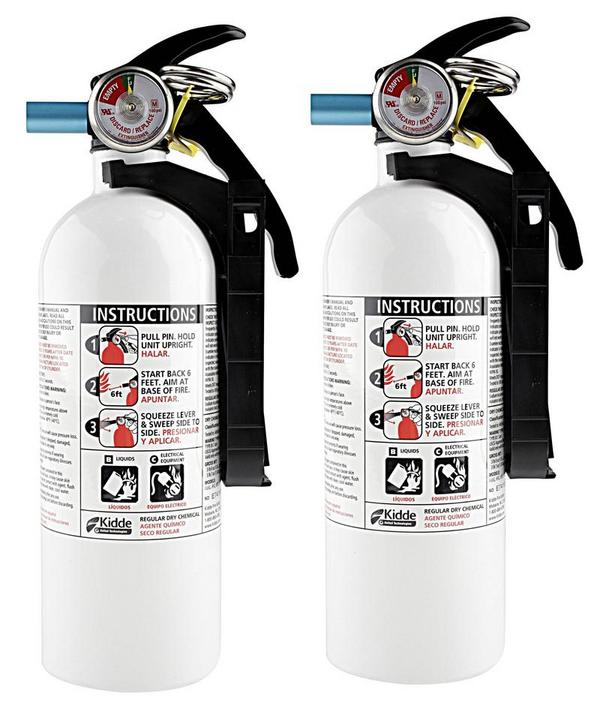
2-Pack Kidde 5-B:C Marine Fire Extinguishers
Expired
$18.65
$37.32
+ Free Store Pickup
+44Deal Score
24,487 Views
Walmart has 2-Pack Kidde 5-B:C Marine Fire Extinguishers on sale for $18.64. Select free store pickup where stock permits, otherwise shipping is free on orders of $35 or more. Thanks GoodDay
Editor's Notes & Price Research
Written by
Availability for store pickup may vary by location. Includes a 6-year limited warranty.
The letter on a fire extinguisher indicates its classification:
Class A puts out ordinary combustible fires (wood, paper, plastic, etc.)
Class B puts out flammable liquid fires (oil, gas, petroleum, etc.)
Class C puts out electrical fires
Class D puts out combustible metal fires (magnesium, titanium, potassium, sodium, etc.)
Class K puts out cooking fires ignited by flammable oil and grease
Since Class A, B, and C fires are all found in conventional homes and businesses, ABC fire extinguishers are designed to put out all three types of fires.
You might come across a fire extinguisher labelled 4A:20B:C. The numbers indicate the size rating of each extinguishing agent. Here's how it works:
The Class A size rating represents the water equivalency. Each number represents 1 ¼ gallons of water. For instance, 2A means the extinguisher is just as effective as 2 ½ gallons of water. 4A is equivalent to 5 gallons of water.
The Class B size rating indicates the square footage the extinguisher can cover. 20B means that as long as you sweep the nozzle side to side, there is enough extinguishing agent inside the canister to provide 20 square feet of coverage.
There is no size rating for Class C. After all, a Class C electrical fire is nothing more than a Class A or Class B fire with energized components requiring a non-conductive extinguishing medium. To effectively fight Class C fires, choose your extinguishers based on the Class A and Class B size ratings.
There is also no size rating for Class D fires. The effectiveness is detailed on the nameplate based on the specific combustible metal for which the extinguisher is recommended.
The big difference with BC extinguishers vs ABC are the BC use baking soda as their extinguishing agent. Its non-toxic and easy to clean up. ABC agent is incredibly messy, dangerous to breathe in, and will basically solidify making it extremely difficult to clean up. It's also corrosive.
Now granted, fire and its fumes will do way more damage and be way more dangerous. But if you have the choice between an ABC or a BC for a small grease or engine fire, the BC should absolutely be used. This is why you find BC extinguishers in kitchens, boats, and vehicles where a class A fire is less likely.
I will add one recommendation- keep a box of baking soda under the sink or somewhere nearby the stove. It is always better to dump that on a small grease fire.
The letter is the type of fire that it is designed for and this lacks the stuff to fight common combustibles in a home.
Just got a single bottle of this exact extinguisher from Home Depot a few weeks ago for $20. I stood there comparing the "automotive" and "marine" ones for way too long. As far as I could tell, they are both the same except the automotive version is a slimmer bottle with less volume.
Is this good for a house? I don't know what 5-b:C means.
The letter on a fire extinguisher indicates its classification:
Class A puts out ordinary combustible fires (wood, paper, plastic, etc.)
Class B puts out flammable liquid fires (oil, gas, petroleum, etc.)
Class C puts out electrical fires
Class D puts out combustible metal fires (magnesium, titanium, potassium, sodium, etc.)
Class K puts out cooking fires ignited by flammable oil and grease
Since Class A, B, and C fires are all found in conventional homes and businesses, ABC fire extinguishers are designed to put out all three types of fires.
You might come across a fire extinguisher labelled 4A:20B:C. The numbers indicate the size rating of each extinguishing agent. Here's how it works:
The Class A size rating represents the water equivalency. Each number represents 1 ¼ gallons of water. For instance, 2A means the extinguisher is just as effective as 2 ½ gallons of water. 4A is equivalent to 5 gallons of water.
The Class B size rating indicates the square footage the extinguisher can cover. 20B means that as long as you sweep the nozzle side to side, there is enough extinguishing agent inside the canister to provide 20 square feet of coverage.
There is no size rating for Class C. After all, a Class C electrical fire is nothing more than a Class A or Class B fire with energized components requiring a non-conductive extinguishing medium. To effectively fight Class C fires, choose your extinguishers based on the Class A and Class B size ratings.
There is also no size rating for Class D fires. The effectiveness is detailed on the nameplate based on the specific combustible metal for which the extinguisher is recommended.
Just got a single bottle of this exact extinguisher from Home Depot a few weeks ago for $20. I stood there comparing the "automotive" and "marine" ones for way too long. As far as I could tell, they are both the same except the automotive version is a slimmer bottle with less volume.
I've seen the exact same model but different mounting brackets in the box. Confirmed this with a manufacturer, too.
There are different requirements for automotive and marine but they overlap a lot - vibration resistance, for example, and the likely types of fires, like a fuel spill. So the same bottle can and does get rated for both.
The big difference with BC extinguishers vs ABC are the BC use baking soda as their extinguishing agent. Its non-toxic and easy to clean up. ABC agent is incredibly messy, dangerous to breathe in, and will basically solidify making it extremely difficult to clean up. It's also corrosive.
Now granted, fire and its fumes will do way more damage and be way more dangerous. But if you have the choice between an ABC or a BC for a small grease or engine fire, the BC should absolutely be used. This is why you find BC extinguishers in kitchens, boats, and vehicles where a class A fire is less likely.
I will add one recommendation- keep a box of baking soda under the sink or somewhere nearby the stove. It is always better to dump that on a small grease fire.


33 Comments
Your comment cannot be blank.
Featured Comments
Class A puts out ordinary combustible fires (wood, paper, plastic, etc.)
Class B puts out flammable liquid fires (oil, gas, petroleum, etc.)
Class C puts out electrical fires
Class D puts out combustible metal fires (magnesium, titanium, potassium, sodium, etc.)
Class K puts out cooking fires ignited by flammable oil and grease
Since Class A, B, and C fires are all found in conventional homes and businesses, ABC fire extinguishers are designed to put out all three types of fires.
You might come across a fire extinguisher labelled 4A:20B:C. The numbers indicate the size rating of each extinguishing agent. Here's how it works:
The Class A size rating represents the water equivalency. Each number represents 1 ¼ gallons of water. For instance, 2A means the extinguisher is just as effective as 2 ½ gallons of water. 4A is equivalent to 5 gallons of water.
The Class B size rating indicates the square footage the extinguisher can cover. 20B means that as long as you sweep the nozzle side to side, there is enough extinguishing agent inside the canister to provide 20 square feet of coverage.
There is no size rating for Class C. After all, a Class C electrical fire is nothing more than a Class A or Class B fire with energized components requiring a non-conductive extinguishing medium. To effectively fight Class C fires, choose your extinguishers based on the Class A and Class B size ratings.
There is also no size rating for Class D fires. The effectiveness is detailed on the nameplate based on the specific combustible metal for which the extinguisher is recommended.
Now granted, fire and its fumes will do way more damage and be way more dangerous. But if you have the choice between an ABC or a BC for a small grease or engine fire, the BC should absolutely be used. This is why you find BC extinguishers in kitchens, boats, and vehicles where a class A fire is less likely.
I will add one recommendation- keep a box of baking soda under the sink or somewhere nearby the stove. It is always better to dump that on a small grease fire.
A: Dry stuff (wood, paper, etc.)
B: Liquids (oil, gas, grease, etc.)
C: Electrical
The number refers to the size and 5 is smaller than what is usually recommended for home use.
Sign up for a Slickdeals account to remove this ad.
Class A puts out ordinary combustible fires (wood, paper, plastic, etc.)
Class B puts out flammable liquid fires (oil, gas, petroleum, etc.)
Class C puts out electrical fires
Class D puts out combustible metal fires (magnesium, titanium, potassium, sodium, etc.)
Class K puts out cooking fires ignited by flammable oil and grease
Since Class A, B, and C fires are all found in conventional homes and businesses, ABC fire extinguishers are designed to put out all three types of fires.
You might come across a fire extinguisher labelled 4A:20B:C. The numbers indicate the size rating of each extinguishing agent. Here's how it works:
The Class A size rating represents the water equivalency. Each number represents 1 ¼ gallons of water. For instance, 2A means the extinguisher is just as effective as 2 ½ gallons of water. 4A is equivalent to 5 gallons of water.
The Class B size rating indicates the square footage the extinguisher can cover. 20B means that as long as you sweep the nozzle side to side, there is enough extinguishing agent inside the canister to provide 20 square feet of coverage.
There is no size rating for Class C. After all, a Class C electrical fire is nothing more than a Class A or Class B fire with energized components requiring a non-conductive extinguishing medium. To effectively fight Class C fires, choose your extinguishers based on the Class A and Class B size ratings.
There is also no size rating for Class D fires. The effectiveness is detailed on the nameplate based on the specific combustible metal for which the extinguisher is recommended.
A: Dry stuff (wood, paper, etc.)
B: Liquids (oil, gas, grease, etc.)
C: Electrical
The number refers to the size and 5 is smaller than what is usually recommended for home use.
Sign up for a Slickdeals account to remove this ad.
You would want A B C for home use.
There are different requirements for automotive and marine but they overlap a lot - vibration resistance, for example, and the likely types of fires, like a fuel spill. So the same bottle can and does get rated for both.
Now granted, fire and its fumes will do way more damage and be way more dangerous. But if you have the choice between an ABC or a BC for a small grease or engine fire, the BC should absolutely be used. This is why you find BC extinguishers in kitchens, boats, and vehicles where a class A fire is less likely.
I will add one recommendation- keep a box of baking soda under the sink or somewhere nearby the stove. It is always better to dump that on a small grease fire.
https://www.guardianfir