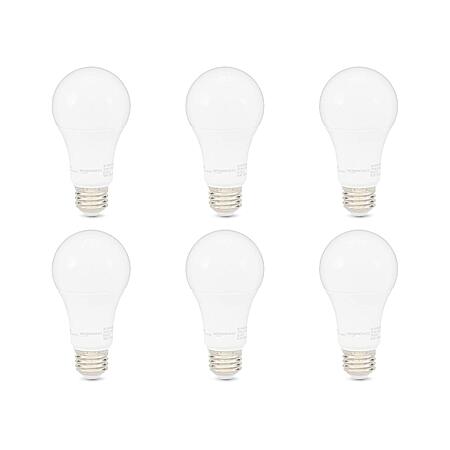
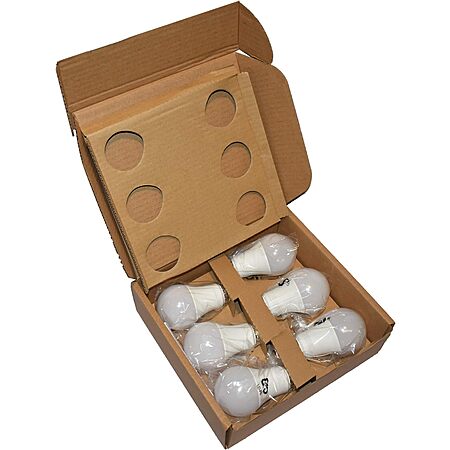
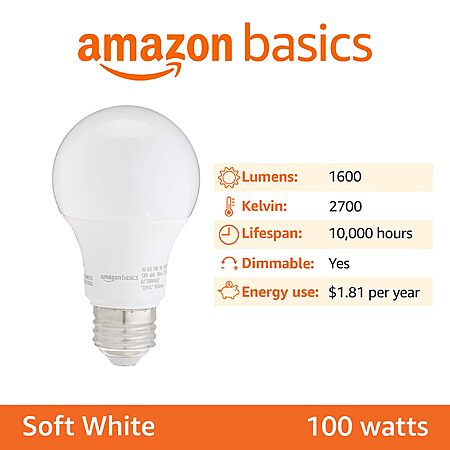
Amazon[amazon.com] has 6-Pack Amazon Basics Dimmable A19 15W (100W Equivalent) LED Light Bulbs (1600 Lumens, 2700K) for $10.49 - 5% Subscribe and Save = $9.97 - Shipping is free w/ Prime or on $35+
This collaborative space allows users to contribute additional information, tips, and insights to enhance the original deal post. Feel free to share your knowledge and help fellow shoppers make informed decisions.
Amazon[amazon.com] has 6-Pack Amazon Basics Dimmable A19 15W (100W Equivalent) LED Light Bulbs (1600 Lumens, 2700K) for $10.49 - 5% Subscribe and Save = $9.97 - Shipping is free w/ Prime or on $35+
Model: Amazon Basics A19 LED Light Bulb, 100 Watt Equivalent, Energy Efficient 15W, E26 Standard Base, Soft White 2700K, Dimmable, 10,000 Hour Lifetime , 6-Pack
Deal History
Deal History includes data from multiple reputable stores, such as Best Buy, Target, and Walmart. The lowest price among stores for a given day is selected as the "Sale Price".
Sale Price does not include sale prices at Amazon unless a deal was posted by a community member.
The Amazon Basics LED Light Bulbs have a Color Rendering Index (CRI) of 80.
What this means for you:
CRI of 80 provides good color accuracy for most home lighting needs
Colors will appear natural and vibrant, though not quite as accurate as higher CRI bulbs (90+)
Perfect for general lighting, reading, and everyday tasks
Industry standard for quality residential LED bulbs
For comparison, sunlight has a CRI of 100, and anything above 80 is considered good quality for home use. At CRI 80, these bulbs will make your home look warm and inviting with the 2700K soft white color temperature.
Our community has rated this post as helpful. If you agree, why not thank ronder
Quote
from AtTheLeftThere
:
The Amazon Basics LED Light Bulbs have a Color Rendering Index (CRI) of 80.What this means for you:CRI of 80 provides good color accuracy for most home lighting needsColors will appear natural and vibrant, though not quite as accurate as higher CRI bulbs (90+)Perfect for general lighting, reading, and everyday tasksIndustry standard for quality residential LED bulbsFor comparison, sunlight has a CRI of 100, and anything above 80 is considered good quality for home use. At CRI 80, these bulbs will make your home look warm and inviting with the 2700K soft white color temperature.
Really? 80 is basically as low as it gets for LED bulbs. Still better than a CFL with a CRI of 50 though. Considering how long LED bulbs usually last, I'd pay a few more bucks and get ones with the highest CRI you can.
Yeah, I really can't stand the yellowish soft white.
I agree, but I can't stand "daylight", either. Well, let me qualify that, as there is a time (literally) and place for the spectrum.
I don't mind 2700K in my nightstand lamps and outdoor decorative (non-security) lighting. I have lots of these with low CRI from years ago when they were all over my house; yeah, they're pretty darn yellow, but I only use them when it's pitch black outside and the warmer color is relaxing. They're great for ambiance.
I don't mind 5000K in my garage, crawl space, motion-sensor security lighting, certain closets, and some task lights, but it can feel a little harsh in some environments and I've been replacing the closet and task lights with 4000K as the others burn out. I find the 4000K to be more neutral than the slightly blue 5000K and are preferred when neutrality and clarity are important.
Most living area lamps, bedroom cans, and living room cans get 3000K. Overhead lights in bathrooms, kitchen, office, dining room, and hallways get 3500K bulbs. All of these are high CRI, so even the 3000K are significantly cleaner than the 2700K.
On top of all that, we have these little 2000K (yep, "amber") nightlights all over the house. They're made by Jasco and sold under the GE brand, but since I bought, like, 20 of them 7 or 8 years ago at $1 per, they're stupid expensive and hard to find now. I absolutely love them, though I'm sure the idea of orange light all over the house at night sounds terrible to some folks.
Lighting is pretty personal, plus the variability in the bulbs themselves and the environment all play a role in what looks "good". Plastic vs glass, frosted vs clear, CRI, paint color, natural light, time of day...there's no objectively "right" bulb, only what works best for a given person, space, and purpose.
There are a ton of graphics that try to demonstrate the different in color between various bulb temperatures. This one always seems to be a better representation of how I perceive the different temps, though. To my eye, there's a huge difference in 2700K vs 3000K vs 3500K vs 4000K and why I use all four in different places throughout the house. A lot of people probably either don't see much of a difference or don't think the difference is enough. Personally, I cannot think of a single instance where I'd want anything higher than 5000K. Maybe they're used in prisons?
My go-to bulb for a long time was/is EcoSmart (Home Depot's brand, I think?). Their "bright white" (3000K) and "true white" (3500K) were available for pretty cheap (4/$10) years ago when glass LEDs with a CRI of 90 were way more expensive. I think they've changed fairly recently and now they have this LED with selectable temperature (2700K/3000K/3500K/4000K/5000K/6500K) and a CRI of 90. 4/$11 for 60W equivalent and 4/$17 for 100W. They're really ugly, but if you're using them in a location where you don't really see the bulb itself (or at least not the base), I think they're pretty good:
While I'm going on way too long about lighting, I tried the GE Reveal HD+ (supposedly 2950K) bulbs once. I don't know what the hell they're doing, but it was awful for me in the kitchen. Everything had a reddish or rosy cast to it. Yuck.
Last edited by rczrider April 29, 2026 at 08:57 AM.











Leave a Comment
9 Comments
Sign up for a Slickdeals account to remove this ad.
What this means for you:
CRI of 80 provides good color accuracy for most home lighting needs
Colors will appear natural and vibrant, though not quite as accurate as higher CRI bulbs (90+)
Perfect for general lighting, reading, and everyday tasks
Industry standard for quality residential LED bulbs
For comparison, sunlight has a CRI of 100, and anything above 80 is considered good quality for home use. At CRI 80, these bulbs will make your home look warm and inviting with the 2700K soft white color temperature.
Sign up for a Slickdeals account to remove this ad.
Our community has rated this post as helpful. If you agree, why not thank ronder
I don't mind 2700K in my nightstand lamps and outdoor decorative (non-security) lighting. I have lots of these with low CRI from years ago when they were all over my house; yeah, they're pretty darn yellow, but I only use them when it's pitch black outside and the warmer color is relaxing. They're great for ambiance.
I don't mind 5000K in my garage, crawl space, motion-sensor security lighting, certain closets, and some task lights, but it can feel a little harsh in some environments and I've been replacing the closet and task lights with 4000K as the others burn out. I find the 4000K to be more neutral than the slightly blue 5000K and are preferred when neutrality and clarity are important.
Most living area lamps, bedroom cans, and living room cans get 3000K. Overhead lights in bathrooms, kitchen, office, dining room, and hallways get 3500K bulbs. All of these are high CRI, so even the 3000K are significantly cleaner than the 2700K.
On top of all that, we have these little 2000K (yep, "amber") nightlights all over the house. They're made by Jasco and sold under the GE brand, but since I bought, like, 20 of them 7 or 8 years ago at $1 per, they're stupid expensive and hard to find now. I absolutely love them, though I'm sure the idea of orange light all over the house at night sounds terrible to some folks.
https://www.amazon.com/GE-SleepLi...B07VP
Lighting is pretty personal, plus the variability in the bulbs themselves and the environment all play a role in what looks "good". Plastic vs glass, frosted vs clear, CRI, paint color, natural light, time of day...there's no objectively "right" bulb, only what works best for a given person, space, and purpose.
There are a ton of graphics that try to demonstrate the different in color between various bulb temperatures. This one always seems to be a better representation of how I perceive the different temps, though. To my eye, there's a huge difference in 2700K vs 3000K vs 3500K vs 4000K and why I use all four in different places throughout the house. A lot of people probably either don't see much of a difference or don't think the difference is enough. Personally, I cannot think of a single instance where I'd want anything higher than 5000K. Maybe they're used in prisons?
https://cdn.shopify.com/s/files/1...4x1024.png
My go-to bulb for a long time was/is EcoSmart (Home Depot's brand, I think?). Their "bright white" (3000K) and "true white" (3500K) were available for pretty cheap (4/$10) years ago when glass LEDs with a CRI of 90 were way more expensive. I think they've changed fairly recently and now they have this LED with selectable temperature (2700K/3000K/3500K/4000K/5000K/6500K) and a CRI of 90. 4/$11 for 60W equivalent and 4/$17 for 100W. They're really ugly, but if you're using them in a location where you don't really see the bulb itself (or at least not the base), I think they're pretty good:
https://www.homedepot.c
While I'm going on way too long about lighting, I tried the GE Reveal HD+ (supposedly 2950K) bulbs once. I don't know what the hell they're doing, but it was awful for me in the kitchen. Everything had a reddish or rosy cast to it. Yuck.
Leave a Comment