Sports Research via Amazon has
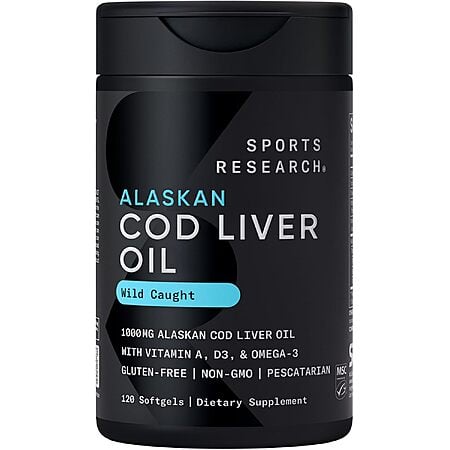
120-Count Sports Research Omega-3 Wild Alaskan Cod Liver Oil Softgels (1000mg) on sale for $22.46 - 30% when you clip the coupon on the product page - 10% when you check out via Subscribe & Save =
$13.47.
Shipping is free with Prime or on $35+ orders.
Thanks to Deal Hunter
Navy-Wife for sharing this deal.
Note: You must be logged into your account. Coupons are typically one use and availability may vary by account. Manage
subscriptions anytime after your order ships. Add
filler/
deals & save up to 15% w/ 5+ monthly items.
About this item:
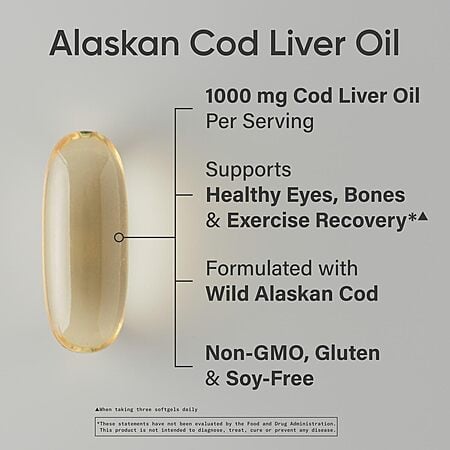
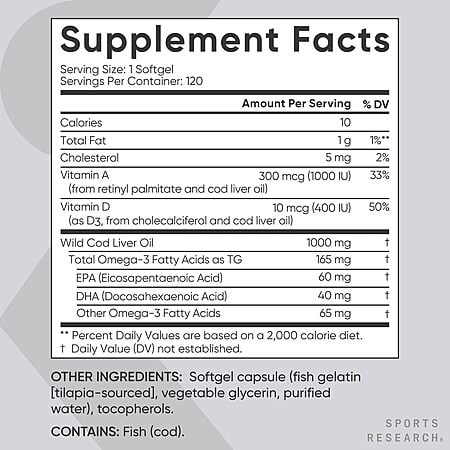
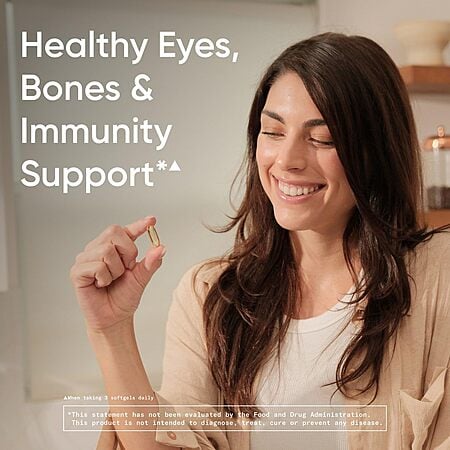
- 1 softgel contains 300 mcg of Vitamin A, 10 mcg of D3 and 165 mg of Omega 3 to support healthy eyes, bones and immunity.
- Just because it's fish doesn't mean it has to taste like it. Our Cod Liver Oil softgels have no fishy taste and they're pescatarian-friendly.
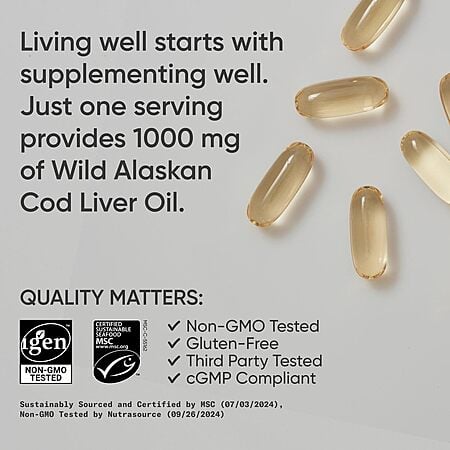
- Our Cod Liver Oil is IGEN NON-GMO tested, IFOS Certified and MSC Sustainable.


 w/ S&Sat Amazon


Top Comments
Direct cod liver oil evidence
• Respiratory/COVID prevention — negative. The largest dedicated RCT, a quadruple-blinded trial of 34,601 Norwegian adults, found cod liver oil (5 mL/day) did not reduce SARS-CoV-2 infection, serious COVID-19, or other acute respiratory infections versus placebo. This is the strongest direct trial and it is null.
• Type 1 diabetes — observational only. A Norwegian population-based case-control study found cod liver oil use in the first year of life was associated with lower risk of childhood-onset type 1 diabetes (adjusted OR 0.74, 95% CI 0.56–0.99), hypothesized to reflect anti-inflammatory n-3 effects. This is hypothesis-generating, not interventional.
• Pediatric upper respiratory infections — weak. A small cluster-randomized study suggested fewer URI visits with cod liver oil plus a multivitamin, but the design and confounding limit inference.
• Bone mineral density — essentially null. An Icelandic cohort found no meaningful association between lifelong cod liver oil intake and hip BMD in old age; the only benefit was a predictable rise in serum 25(OH)D.
Extrapolated omega-3 evidence (the strongest signals)
• Rheumatoid arthritis has the most consistent (though modest) benefit of any indication. Marine n-3 PUFAs reduce tender joint count, morning stiffness, and NSAID use across systematic reviews, with effect sizes that are small and evidence often low-certainty; anti-inflammatory doses (≥2.7 g/day n-3) exceed what a typical cod liver oil dose delivers. Of note, cod liver oil was historically first used for RA in the 1700s.
• Cardiovascular disease benefit is limited and dose-dependent. The 2020 Cochrane review (86 RCTs, ~163,000 participants) found little or no effect of n-3 supplementation on all-cause or cardiovascular mortality, with at most a slight reduction in coronary events. Any cardioprotective signal (e.g., REDUCE-IT) came from high-dose prescription icosapent ethyl (4 g/day), far above cod liver oil content.
• Vitamin D delivery is the one undisputed physiologic effect: cod liver oil reliably raises serum 25(OH)D in a dose-dependent manner.
Join The Conversation
Share your experience with the Slickdeals community
Share information with the community. Please follow our Community Guidelines and be kind!
15 Comments
Sign up for a Slickdeals account to remove this ad.
Sign up for a Slickdeals account to remove this ad.
Our community has rated this post as helpful. If you agree, why not thank
Our community has rated this post as helpful. If you agree, why not thank
Did it disappear after a few sales?
Is this a trick brands use to push products?
Our community has rated this post as helpful. If you agree, why not thank
Direct cod liver oil evidence
• Respiratory/COVID prevention — negative. The largest dedicated RCT, a quadruple-blinded trial of 34,601 Norwegian adults, found cod liver oil (5 mL/day) did not reduce SARS-CoV-2 infection, serious COVID-19, or other acute respiratory infections versus placebo. This is the strongest direct trial and it is null. [1]
• Type 1 diabetes — observational only. A Norwegian population-based case-control study found cod liver oil use in the first year of life was associated with lower risk of childhood-onset type 1 diabetes (adjusted OR 0.74, 95% CI 0.56–0.99), hypothesized to reflect anti-inflammatory n-3 effects. This is hypothesis-generating, not interventional. [2]
• Pediatric upper respiratory infections — weak. A small cluster-randomized study suggested fewer URI visits with cod liver oil plus a multivitamin, but the design and confounding limit inference. [3]
• Bone mineral density — essentially null. An Icelandic cohort found no meaningful association between lifelong cod liver oil intake and hip BMD in old age; the only benefit was a predictable rise in serum 25(OH)D. [4]
Extrapolated omega-3 evidence (the strongest signals)
• Rheumatoid arthritis has the most consistent (though modest) benefit of any indication. Marine n-3 PUFAs reduce tender joint count, morning stiffness, and NSAID use across systematic reviews, with effect sizes that are small and evidence often low-certainty; anti-inflammatory doses (≥2.7 g/day n-3) exceed what a typical cod liver oil dose delivers. Of note, cod liver oil was historically first used for RA in the 1700s. [5-9]
• Cardiovascular disease benefit is limited and dose-dependent. The 2020 Cochrane review (86 RCTs, ~163,000 participants) found little or no effect of n-3 supplementation on all-cause or cardiovascular mortality, with at most a slight reduction in coronary events. Any cardioprotective signal (e.g., REDUCE-IT) came from high-dose prescription icosapent ethyl (4 g/day), far above cod liver oil content. [10-12]
• Vitamin D delivery is the one undisputed physiologic effect: cod liver oil reliably raises serum 25(OH)D in a dose-dependent manner. [4]
Our community has rated this post as helpful. If you agree, why not thank
Sign up for a Slickdeals account to remove this ad.
Join The Conversation
Share your experience with the Slickdeals community
Share information with the community. Please follow our Community Guidelines and be kind!