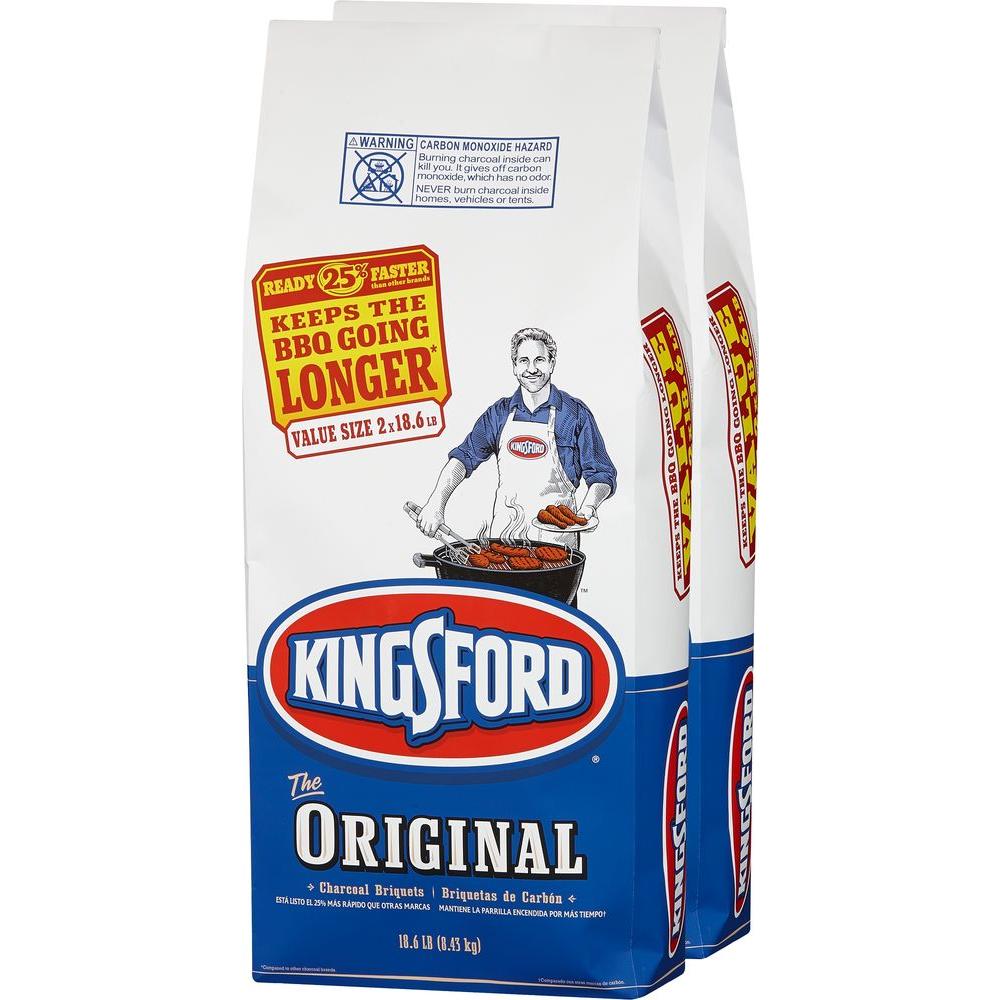
2-Pack of 18.6 lbs Kingsford Charcoal Briquettes
Expired
$10
+ Free Store Pickup
+188Deal Score
56,241 Views
Home Depot.com has 2-Pack Kingsford 18.6lbs Charcoal Briquettes (Total 37.2 lbs) on sale for $9.88. Select free in-store pickup to save on shipping. Thanks smart84
Note, availability for in-store pickup may vary depending on location.
Editor's Notes & Price Research
Written by
Easy to light Kingsford charcoal briquettes (sure fire grooves). Great to stock up for tailgating, picnicking or backyard barbecues.
Sale is valid through 4/2 or while supplies last. This has been a popular deal several times before and matches several prior Frontpage deals. -Corwin
There is no discernible difference between the health risks from regular Kingsford versus the professional or any other branded charcoal for that matter. Anyone speaking to the contrary is misinformed. The only variances are heat, speed of burn and ash over time.
Charcoal is formed by taking charcoal fines (dust) and compressing it together using a binding agent. This binding agent is typically starch but can also be chemical in nature. The Kingsford professional product primarily uses starch allowing Kingsford to call it "natural".
The different binding agents along with different hardwoods are what cause the different odors - particularly at start up. Your health risk is minimal using either the professional product, regular blue bag or most any other product as there are not that many companies actually producing charcoal.
As far as health risks the concerns are:
Inhaling fine dust
the actual char that forms on the food
HCA or PAH (which to my knowledge have not yet been shown to cause cancer in humans and only occur at very high temperatures making low temp smoking a not issue with almost any product)
Source - I worked as a sales manager for a large charcoal company
.
I see your spreading FUD here too! Just to reiterate what I posted in the Lowes thread:
Just for fun, thought I'd throw you some info I found to refute your wild claim "Lots of chemicals"
Here is the official ingredient list for Kingsford Charcoal Briquets from a company press release
Wood char (Heat source)
This is simply the wood by-products I mentioned above, burned down into charcoal—almost pure carbon. In the case of Kingsford, they use woods like fir, cedar, and alder that are local to the regions in which they operate—Burnside and Summer Shade, Kentucky; Glen, Mississippi; Belle, Missouri; Springfield, Oregon; and Beryl and Parsons, West Virginia.
Mineral char (Heat source)
This is a geologically young form of coal with a soft, brown texture. It helps Kingsford burn hotter and longer than a plain charcoal briquette. As with the wood, Kingsford heats this material in an oxygen-controlled environment, eliminating water, nitrogen, and other elements, leaving behind—almost pure carbon.
Mineral carbon (Heat source)
This is anthracite coal, the old, hard, black stuff once commonly used for home heating. It helps Kingsford burn hotter and longer than a plain charcoal briquette. It's already 86-98% pure carbon, but once again, Kingsford processes it in an oxygen-controlled environment, leaving behind—almost pure carbon.
What exactly is coal, you ask? "Nasty stuff," some folks say. Well, coal is a fossil fuel, most of which was formed more than 300 million years ago. To make a really, really long story short: Plants and trees died, sank to the bottom of swampy areas, accumulated into many layers, then geologic processes covered the stuff with sand, clay, and rock, and the combination of heat and pressure converted it into what we call coal.
So, coal is really old plant material that can be processed into almost pure carbon. Charcoal is wood that is burned down into almost pure carbon. Not much difference, in my book. End of coal lesson.
Limestone (Uniform visual ashing)
Limestone creates the pretty, white coating of ash you see after lighting the briquettes. Limestone is a sedimentary rock consisting of calcium carbonate—also found in egg shells, antacids, and calcium dietary supplements.
Starch (Binder)
As mentioned above, starch is used to hold briquettes together, and is found in corn, wheat, potatoes, and rice.
Borax (Press release)
Borax is used in small amounts to help briquettes release from the molds. But isn't Borax a detergent? Well, yes, it is, but it's actually a naturally-occurring mineral that is non-toxic in the quantities we're talking about in a briquette. It consists of sodium, boron, oxygen, and water. You already know what oxygen and water are. Sodium is a common element found in lots of stuff we eat, including salt. Boron is an element that is necessary in small quantities for plant growth. Borax is commonly used in cosmetics and medicines.
Sodium nitrate (Ignition aid)
This is the same stuff used to cure meat. According to Robert L. Wolke, professor emeritus of chemistry at the University of Pittsburgh, sodium nitrate gives off oxygen when heated, helping the briquettes to light faster.
Sawdust (Ignition aid)
Sawdust burns quickly, helping the briquettes to light faster.
Have fun trying to explain how this is all bad for you! And please, if you do, back up with some extensive scientific evidence!
haven't used the pro ones, yes the normal ones give off some nasty smelling fumes while they are burning initially, but that smell goes away once they are ready to use
i did read that the pro version burns more cleanly, that there will be less ash at the end of it... but i also read they burn quicker iirc
Can you provide some facts about this? How do you know the ones in Costco are better? I am trying to decide between the two.
There is no discernible difference between the health risks from regular Kingsford versus the professional or any other branded charcoal for that matter. Anyone speaking to the contrary is misinformed. The only variances are heat, speed of burn and ash over time.
Charcoal is formed by taking charcoal fines (dust) and compressing it together using a binding agent. This binding agent is typically starch but can also be chemical in nature. The Kingsford professional product primarily uses starch allowing Kingsford to call it "natural".
The different binding agents along with different hardwoods are what cause the different odors - particularly at start up. Your health risk is minimal using either the professional product, regular blue bag or most any other product as there are not that many companies actually producing charcoal.
As far as health risks the concerns are:
Inhaling fine dust
the actual char that forms on the food
HCA or PAH (which to my knowledge have not yet been shown to cause cancer in humans and only occur at very high temperatures making low temp smoking a not issue with almost any product)
Source - I worked as a sales manager for a large charcoal company
.
Professional Model in Costco is $5 more expensive compared with this deal. However, it has
Higher heat
Uses 100% all-natural wood vs chemical
Ready to cook on faster
Release less ash and mess
However, it burns faster, therefore, you can get less cooking time from the same amount of charcoal.
How about smoking or low heat cooking for a long time? Chemicals get in the food in this case anyway and $$$ medical bills are unavoidable.
I see your spreading FUD here too! Just to reiterate what I posted in the Lowes thread:
Just for fun, thought I'd throw you some info I found to refute your wild claim "Lots of chemicals"
Here is the official ingredient list for Kingsford Charcoal Briquets from a company press release
Wood char (Heat source)
This is simply the wood by-products I mentioned above, burned down into charcoal—almost pure carbon. In the case of Kingsford, they use woods like fir, cedar, and alder that are local to the regions in which they operate—Burnside and Summer Shade, Kentucky; Glen, Mississippi; Belle, Missouri; Springfield, Oregon; and Beryl and Parsons, West Virginia.
Mineral char (Heat source)
This is a geologically young form of coal with a soft, brown texture. It helps Kingsford burn hotter and longer than a plain charcoal briquette. As with the wood, Kingsford heats this material in an oxygen-controlled environment, eliminating water, nitrogen, and other elements, leaving behind—almost pure carbon.
Mineral carbon (Heat source)
This is anthracite coal, the old, hard, black stuff once commonly used for home heating. It helps Kingsford burn hotter and longer than a plain charcoal briquette. It's already 86-98% pure carbon, but once again, Kingsford processes it in an oxygen-controlled environment, leaving behind—almost pure carbon.
What exactly is coal, you ask? "Nasty stuff," some folks say. Well, coal is a fossil fuel, most of which was formed more than 300 million years ago. To make a really, really long story short: Plants and trees died, sank to the bottom of swampy areas, accumulated into many layers, then geologic processes covered the stuff with sand, clay, and rock, and the combination of heat and pressure converted it into what we call coal.
So, coal is really old plant material that can be processed into almost pure carbon. Charcoal is wood that is burned down into almost pure carbon. Not much difference, in my book. End of coal lesson.
Limestone (Uniform visual ashing)
Limestone creates the pretty, white coating of ash you see after lighting the briquettes. Limestone is a sedimentary rock consisting of calcium carbonate—also found in egg shells, antacids, and calcium dietary supplements.
Starch (Binder)
As mentioned above, starch is used to hold briquettes together, and is found in corn, wheat, potatoes, and rice.
Borax (Press release)
Borax is used in small amounts to help briquettes release from the molds. But isn't Borax a detergent? Well, yes, it is, but it's actually a naturally-occurring mineral that is non-toxic in the quantities we're talking about in a briquette. It consists of sodium, boron, oxygen, and water. You already know what oxygen and water are. Sodium is a common element found in lots of stuff we eat, including salt. Boron is an element that is necessary in small quantities for plant growth. Borax is commonly used in cosmetics and medicines.
Sodium nitrate (Ignition aid)
This is the same stuff used to cure meat. According to Robert L. Wolke, professor emeritus of chemistry at the University of Pittsburgh, sodium nitrate gives off oxygen when heated, helping the briquettes to light faster.
Sawdust (Ignition aid)
Sawdust burns quickly, helping the briquettes to light faster.
Have fun trying to explain how this is all bad for you! And please, if you do, back up with some extensive scientific evidence!


110 Comments
Your comment cannot be blank.
Featured Comments
Charcoal is formed by taking charcoal fines (dust) and compressing it together using a binding agent. This binding agent is typically starch but can also be chemical in nature. The Kingsford professional product primarily uses starch allowing Kingsford to call it "natural".
The different binding agents along with different hardwoods are what cause the different odors - particularly at start up. Your health risk is minimal using either the professional product, regular blue bag or most any other product as there are not that many companies actually producing charcoal.
As far as health risks the concerns are:
Inhaling fine dust
the actual char that forms on the food
HCA or PAH (which to my knowledge have not yet been shown to cause cancer in humans and only occur at very high temperatures making low temp smoking a not issue with almost any product)
Source - I worked as a sales manager for a large charcoal company
.
Just for fun, thought I'd throw you some info I found to refute your wild claim "Lots of chemicals"
Here is the official ingredient list for Kingsford Charcoal Briquets from a company press release
Wood char (Heat source)
This is simply the wood by-products I mentioned above, burned down into charcoal—almost pure carbon. In the case of Kingsford, they use woods like fir, cedar, and alder that are local to the regions in which they operate—Burnside and Summer Shade, Kentucky; Glen, Mississippi; Belle, Missouri; Springfield, Oregon; and Beryl and Parsons, West Virginia.
Mineral char (Heat source)
This is a geologically young form of coal with a soft, brown texture. It helps Kingsford burn hotter and longer than a plain charcoal briquette. As with the wood, Kingsford heats this material in an oxygen-controlled environment, eliminating water, nitrogen, and other elements, leaving behind—almost pure carbon.
Mineral carbon (Heat source)
This is anthracite coal, the old, hard, black stuff once commonly used for home heating. It helps Kingsford burn hotter and longer than a plain charcoal briquette. It's already 86-98% pure carbon, but once again, Kingsford processes it in an oxygen-controlled environment, leaving behind—almost pure carbon.
What exactly is coal, you ask? "Nasty stuff," some folks say. Well, coal is a fossil fuel, most of which was formed more than 300 million years ago. To make a really, really long story short: Plants and trees died, sank to the bottom of swampy areas, accumulated into many layers, then geologic processes covered the stuff with sand, clay, and rock, and the combination of heat and pressure converted it into what we call coal.
So, coal is really old plant material that can be processed into almost pure carbon. Charcoal is wood that is burned down into almost pure carbon. Not much difference, in my book. End of coal lesson.
Limestone (Uniform visual ashing)
Limestone creates the pretty, white coating of ash you see after lighting the briquettes. Limestone is a sedimentary rock consisting of calcium carbonate—also found in egg shells, antacids, and calcium dietary supplements.
Starch (Binder)
As mentioned above, starch is used to hold briquettes together, and is found in corn, wheat, potatoes, and rice.
Borax (Press release)
Borax is used in small amounts to help briquettes release from the molds. But isn't Borax a detergent? Well, yes, it is, but it's actually a naturally-occurring mineral that is non-toxic in the quantities we're talking about in a briquette. It consists of sodium, boron, oxygen, and water. You already know what oxygen and water are. Sodium is a common element found in lots of stuff we eat, including salt. Boron is an element that is necessary in small quantities for plant growth. Borax is commonly used in cosmetics and medicines.
Sodium nitrate (Ignition aid)
This is the same stuff used to cure meat. According to Robert L. Wolke, professor emeritus of chemistry at the University of Pittsburgh, sodium nitrate gives off oxygen when heated, helping the briquettes to light faster.
Sawdust (Ignition aid)
Sawdust burns quickly, helping the briquettes to light faster.
Have fun trying to explain how this is all bad for you! And please, if you do, back up with some extensive scientific evidence!
Cooking meat over high temps is bad for you also [cancer.gov]......just saying!
Sign up for a Slickdeals account to remove this ad.
https://www.costco.com/warehouse-...ffers.html [costco.com]
i did read that the pro version burns more cleanly, that there will be less ash at the end of it... but i also read they burn quicker iirc
Agree!
Charcoal is formed by taking charcoal fines (dust) and compressing it together using a binding agent. This binding agent is typically starch but can also be chemical in nature. The Kingsford professional product primarily uses starch allowing Kingsford to call it "natural".
The different binding agents along with different hardwoods are what cause the different odors - particularly at start up. Your health risk is minimal using either the professional product, regular blue bag or most any other product as there are not that many companies actually producing charcoal.
As far as health risks the concerns are:
Inhaling fine dust
the actual char that forms on the food
HCA or PAH (which to my knowledge have not yet been shown to cause cancer in humans and only occur at very high temperatures making low temp smoking a not issue with almost any product)
Source - I worked as a sales manager for a large charcoal company
.
Sign up for a Slickdeals account to remove this ad.
if you wait until april, you can get 5% from discover
https://www.costco.com/warehouse-...ffers.html
However, it burns faster, therefore, you can get less cooking time from the same amount of charcoal.
How about smoking or low heat cooking for a long time? Chemicals get in the food in this case anyway and $$$ medical bills are unavoidable.
I see your spreading FUD here too! Just to reiterate what I posted in the Lowes thread:
Just for fun, thought I'd throw you some info I found to refute your wild claim "Lots of chemicals"
Here is the official ingredient list for Kingsford Charcoal Briquets from a company press release
Wood char (Heat source)
This is simply the wood by-products I mentioned above, burned down into charcoal—almost pure carbon. In the case of Kingsford, they use woods like fir, cedar, and alder that are local to the regions in which they operate—Burnside and Summer Shade, Kentucky; Glen, Mississippi; Belle, Missouri; Springfield, Oregon; and Beryl and Parsons, West Virginia.
Mineral char (Heat source)
This is a geologically young form of coal with a soft, brown texture. It helps Kingsford burn hotter and longer than a plain charcoal briquette. As with the wood, Kingsford heats this material in an oxygen-controlled environment, eliminating water, nitrogen, and other elements, leaving behind—almost pure carbon.
Mineral carbon (Heat source)
This is anthracite coal, the old, hard, black stuff once commonly used for home heating. It helps Kingsford burn hotter and longer than a plain charcoal briquette. It's already 86-98% pure carbon, but once again, Kingsford processes it in an oxygen-controlled environment, leaving behind—almost pure carbon.
What exactly is coal, you ask? "Nasty stuff," some folks say. Well, coal is a fossil fuel, most of which was formed more than 300 million years ago. To make a really, really long story short: Plants and trees died, sank to the bottom of swampy areas, accumulated into many layers, then geologic processes covered the stuff with sand, clay, and rock, and the combination of heat and pressure converted it into what we call coal.
So, coal is really old plant material that can be processed into almost pure carbon. Charcoal is wood that is burned down into almost pure carbon. Not much difference, in my book. End of coal lesson.
Limestone (Uniform visual ashing)
Limestone creates the pretty, white coating of ash you see after lighting the briquettes. Limestone is a sedimentary rock consisting of calcium carbonate—also found in egg shells, antacids, and calcium dietary supplements.
Starch (Binder)
As mentioned above, starch is used to hold briquettes together, and is found in corn, wheat, potatoes, and rice.
Borax (Press release)
Borax is used in small amounts to help briquettes release from the molds. But isn't Borax a detergent? Well, yes, it is, but it's actually a naturally-occurring mineral that is non-toxic in the quantities we're talking about in a briquette. It consists of sodium, boron, oxygen, and water. You already know what oxygen and water are. Sodium is a common element found in lots of stuff we eat, including salt. Boron is an element that is necessary in small quantities for plant growth. Borax is commonly used in cosmetics and medicines.
Sodium nitrate (Ignition aid)
This is the same stuff used to cure meat. According to Robert L. Wolke, professor emeritus of chemistry at the University of Pittsburgh, sodium nitrate gives off oxygen when heated, helping the briquettes to light faster.
Sawdust (Ignition aid)
Sawdust burns quickly, helping the briquettes to light faster.
Have fun trying to explain how this is all bad for you! And please, if you do, back up with some extensive scientific evidence!
Cooking meat over high temps is bad for you also [cancer.gov]......just saying!
Charcoal 60-90% (wood char and West Virginia black lung coal
Limestone < 20%
Wood dust < 10%
Safety Data Sheet for Kingsford Competition (now Professional) [thecloroxcompany.com]
Charcoal 70-90% (supposedly all wood char)
Limestone 3-7%
There's less cement (limestone) and no sawdust, so less ash.