Original Post
Written by
Edited December 18, 2020
at 11:03 AM
by
Looks pretty decent for the price.
Write I/O is not strong, but would serve well as a game drive or a boot drive for lighter workloads. Read I/O is pretty good for a budget TLC drive with DRAM.
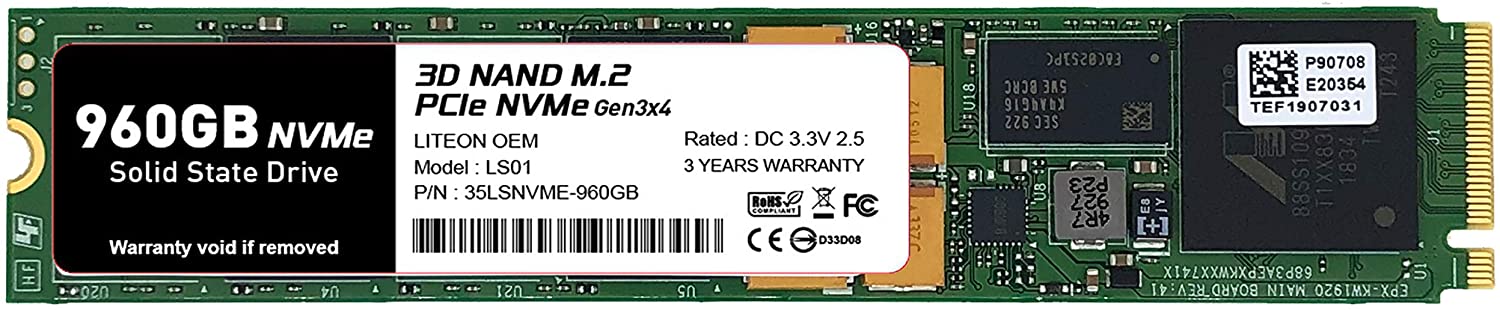
Beware the form factor is 22110, not 2280, which is longer than the common size and won't fit into a lot of slots. Make sure your system supports the form factor.
Specifications:
- Hard-Drive Size:960 GB
- Hard Disk Form Factor: 22110
- Hardware Connectivity:M.2 PCIe NVME
- Sequential read speed: Up to 1700MB/s
- Sequential write speed: Up to 750MB/s
- Random read speed: Up to 460,000 IOPS
- Random write speed: Up to 60,000 IOPS
- Device Type: M.2 22110 110mm PCIe NVMe SSD (Solid State Drive) TLC 3D Nand Flash
https://www.amazon.com/dp/B08DKL514G/


104 Comments
Your comment cannot be blank.
Featured Comments
The reason for the size is because of the foot print of the capacitors. Your typical 2280 won't have capacitors which means they're not power loss safe, relying instead on the capacitors of the motherboard to keep the drive up long enough to dump everything out of DRAM into the NAND.
Or you could pick up something like this: https://www.newegg.com/asus-model...klink=t
and 4 of these SSDs to build yourself your own 4TB SSD for less than $350.
https://www.amazon.com/dp/product/B08GJBTCF6
No, just older, circa 2017, and publishing SUSTAINED speed specs, not burst speeds like most consumer drives. This is a drive meant for an enterprise/datacenter application, and would not have used pSLC caching, meaning that unlike most drives (even consumer drives with DRAM cache), the stated performance numbers are sustainable, and will not fall off a cliff once the drive or cache reaches a certain point.
If this is a OEM version of the Lite-On EPX-KB 960 like I think it is, it should have a Marvell 88SS1093 controller and Toshiba 3D TLC NAND. It should also utilize LiteOn's EPX Intelligent Read Retry (IRR), and come with power loss protection capacitors supporting end-to-end data path protection compatible with the T10 Data Integrity Field spec. (Meaningless for home use, but must haves for a RAID/server implementation.)
TLDR: If you're a home user looking for a cheap 1TB TLC m.2 NVME drive AND are okay with the slower write speeds, larger form factor, and higher idle power consumption, this isn't a bad option, but you won't be able to utilize most of the enterprise features of this drive.
Sign up for a Slickdeals account to remove this ad.
This drive would have been tempting, unfortunately the mobo I'm planning on getting doesn't have a standoff at the 110mm mark.
Our community has rated this post as helpful. If you agree, why not thank jfb.44
This drive would have been tempting, unfortunately the mobo I'm planning on getting doesn't have a standoff at the 110mm mark.
https://www.amazon.com/dp/product/B08GJBTCF6
Edit: It's the gateway creator series. I got my answer, thanks.
Sign up for a Slickdeals account to remove this ad.
Our community has rated this post as helpful. If you agree, why not thank slipperybargainsman
The reason for the size is because of the foot print of the capacitors. Your typical 2280 won't have capacitors which means they're not power loss safe, relying instead on the capacitors of the motherboard to keep the drive up long enough to dump everything out of DRAM into the NAND.
Or you could pick up something like this: https://www.newegg.com/asus-model...klink=t
and 4 of these SSDs to build yourself your own 4TB SSD for less than $350.
Our community has rated this post as helpful. If you agree, why not thank Yianaki
The reason for the size is because of the foot print of the capacitors. Your typical 2280 won't have capacitors which means they're not power loss safe, relying instead on the capacitors of the motherboard to keep the drive up long enough to dump everything out of DRAM into the NAND.
Or you could pick up something like this: https://www.newegg.com/asus-model...klink=t
and 4 of these SSDs to build yourself your own 4TB SSD for less than $350.
Its not that simple... Or do you know how to get all 4 to work as individual drives?