This collaborative space allows users to contribute additional information, tips, and insights to enhance the original deal post. Feel free to share your knowledge and help fellow shoppers make informed decisions.
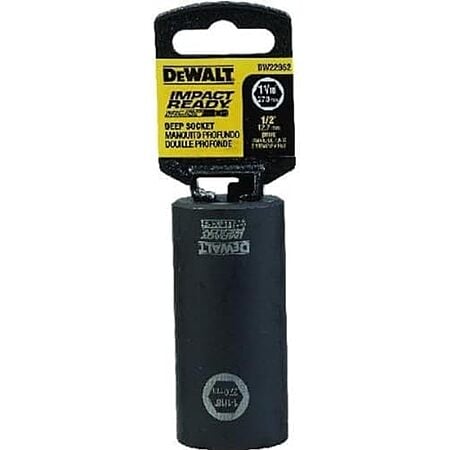
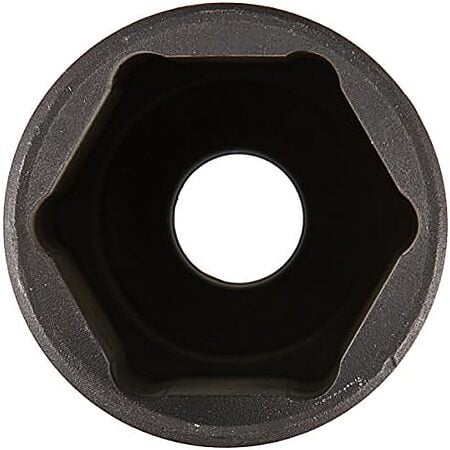
Model: IMPACT READY(R) 1-1/16" 1/2" Drive 6pt Deep Socket
Deal History
Deal History includes data from multiple reputable stores, such as Best Buy, Target, and Walmart. The lowest price among stores for a given day is selected as the "Sale Price".
Sale Price does not include sale prices at Amazon unless a deal was posted by a community member.
this is the exact size you need to change out a water heater anode rod. by the way, don't need a deep socket format to do it no matter what the heater is. people say you do but they are 100% wrong. a regular length 1 1/16 socket will have more than enough clearance to both stick up out of the recess of the anode rod after engaging the head and also enough depth to fully seat the ratchets drive in the socket without the head of the anode rod obstructing it at all. and this is preferred because the regular length (non-deep) socket generates more lateral torque on the bolt head than the deep socket ones do. so that means less of a chance you will need a breaker bar to be involved. i know this all from first hand experience. ace hardware sells a very nice and high quality 1 1/16" DeWalt socket of the shorter regular (non-deep) type for 1/2" drive rachets for only $7.59 (this is the very one I own and use on anode rods), so that's even cheaper than this deal. if you have a 3/8" drive rachet, you need to get a 3/8" to 1/2" drive socket adapter to use these 1/2" sockets. ace also has one of those by DeWalt for $7.99.
Last edited by psychojinx March 5, 2026 at 07:45 AM.
You're right that standard depth sockets work on anode rods, but this part is hooey
" this is preferred because the regular length (non-deep) socket generates more lateral torque on the bolt head than the deep socket ones do"
Regardless, I always recommend using an impact wrench on anode rods to avoid applying force to the pipes. A ratchet (good luck) or breaker bar tends to want to spin the tank because the linear force is distant from the point of rotation. Enough leverage to break the rod free is often enough to overcome the inertia of the tank, even when full. Those rods can be super tight! When I install a water heater for someone, I break the rod free and retighten it sensibly.
You're right that standard depth sockets work on anode rods, but this part is hooey
" this is preferred because the regular length (non-deep) socket generates more lateral torque on the bolt head than the deep socket ones do"
Regardless, I always recommend using an impact wrench on anode rods to avoid applying force to the pipes. A ratchet (good luck) or breaker bar tends to want to spin the tank because the linear force is distant from the point of rotation. Enough leverage to break the rod free is often enough to overcome the inertia of the tank, even when full. Those rods can be super tight! When I install a water heater for someone, I break the rod free and retighten it sensibly.
You are very wrong about the part of my post you called hooey.
Here's the proof why you are wrong. Read it all. You will get a lesson in Physics today:
Q. Wouldn't it be easier (less force needed) to use a normal socket versus a deep socket on an anode rod since the normal socket is lesser in height?
A. Strictly from a physics and stability standpoint, yes, a shallow (normal) socket is better than a deep socket for high-torque jobs like removing a seized anode rod.
Here is why "shorter is better" when things are stuck: 1. Reducing the "Moment Arm" (Tipping Force)
When you use a deep socket, you are moving the ratchet handle further away from the base of the bolt. Even if you try to pull perfectly straight, you inevitably apply a tiny bit of upward or downward force.
Deep Socket: Acts like a mini-lever that wants to tilt the socket off the bolt. This is called "side-loading," and it's the primary cause of rounded bolt heads.
Shallow Socket: Keeps the force of the ratchet handle as close to the threads as possible, making the connection much more stable.
2. Minimizing Torsional Flex
Believe it or not, steel twists. When you apply 100+ lbs of force to a long tool setup, the metal actually "winds up" like a very stiff spring before it starts turning the bolt.
A deep socket has more metal to twist than a shallow one.
By using a shallow socket, more of your physical energy goes directly into turning the rod rather than stretching the tool.












Leave a Comment
4 Comments
Sign up for a Slickdeals account to remove this ad.
" this is preferred because the regular length (non-deep) socket generates more lateral torque on the bolt head than the deep socket ones do"
Regardless, I always recommend using an impact wrench on anode rods to avoid applying force to the pipes. A ratchet (good luck) or breaker bar tends to want to spin the tank because the linear force is distant from the point of rotation. Enough leverage to break the rod free is often enough to overcome the inertia of the tank, even when full. Those rods can be super tight! When I install a water heater for someone, I break the rod free and retighten it sensibly.
" this is preferred because the regular length (non-deep) socket generates more lateral torque on the bolt head than the deep socket ones do"
Regardless, I always recommend using an impact wrench on anode rods to avoid applying force to the pipes. A ratchet (good luck) or breaker bar tends to want to spin the tank because the linear force is distant from the point of rotation. Enough leverage to break the rod free is often enough to overcome the inertia of the tank, even when full. Those rods can be super tight! When I install a water heater for someone, I break the rod free and retighten it sensibly.
Here's the proof why you are wrong. Read it all. You will get a lesson in Physics today:
Q. Wouldn't it be easier (less force needed) to use a normal socket versus a deep socket on an anode rod since the normal socket is lesser in height?
A. Strictly from a physics and stability standpoint, yes, a shallow (normal) socket is better than a deep socket for high-torque jobs like removing a seized anode rod.
Here is why "shorter is better" when things are stuck:
1. Reducing the "Moment Arm" (Tipping Force)
When you use a deep socket, you are moving the ratchet handle further away from the base of the bolt. Even if you try to pull perfectly straight, you inevitably apply a tiny bit of upward or downward force.
- Deep Socket: Acts like a mini-lever that wants to tilt the socket off the bolt. This is called "side-loading," and it's the primary cause of rounded bolt heads.
- Shallow Socket: Keeps the force of the ratchet handle as close to the threads as possible, making the connection much more stable.
2. Minimizing Torsional FlexBelieve it or not, steel twists. When you apply 100+ lbs of force to a long tool setup, the metal actually "winds up" like a very stiff spring before it starts turning the bolt.
Leave a Comment