Original Post
Written by
Edited November 6, 2024
at 05:38 PM
by
Chase is offering
$900 bonus cash back after you spend $6,000 on purchases in the first 3 months from account opening with the
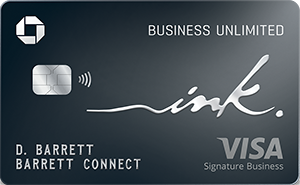
Ink Business Unlimited® Credit Card. The annual fee is $0.
Card Details:
Earn $900 bonus cash back after you spend $6,000 on purchases in the first 3 months from account opening
Earn unlimited 1.5% cash back on every purchase made for your business
No Annual Fee
Redeem rewards for cash back, gift cards, travel and more through Chase Ultimate Rewards®.
Earn rewards faster with employee cards at no additional cost. Set individual spending limits for greater control.
Round-the-clock monitoring for unusual credit card purchases
With Zero Liability you won't be held responsible for unauthorized charges made with your card or account information.
0% introductory APR for 12 months on purchases
Member FDIC
Read our review on the
Ink Business Unlimited® Credit Card
Slickdeals may be compensated by Chase.



384 Comments
Your comment cannot be blank.
Featured Comments
I think someone got their wires crossed between Ink Preferred and Ink Unlimited. Which one is the increased SUB actually for?
Sign up for a Slickdeals account to remove this ad.
What they do is make 1B in say the value of their stock in the company going up- then instead of selling the stock (incurring taxes) they borrow against the stock at lower-than-available-to-the-poors interest rates, and thus avoid having significant taxable income at all.
Not just CEOs, but wealthy people in general- Here's a well known NYU professor explaining it
https://finance.yahoo.c
So long as the assets keep increasing in value as much, or more, then the interest on the loans (which is pretty trivial to do unless you're a REALLY terrible investor- heck at these numbers even government bonds will often pay more than the interest on your asset loans), you keep getting richer while paying no income tax, since loans aren't income.
Even better- that interest is often deductible, so you can use it to offset what income you DO have and avoid taxes on that too.
There's some added complexity for stock-based compensation like huge options packages--- those you're going to get forced into paying taxes on- but all that really means is some % of the SBC is sold off to cover the tax bill on the remaining, majority, of the SBC-- and you then use the method described at the top to never have to sell or be taxed on further gains on the remaining stock.
And as you said, they already got tax on that stock option grant as ordinary income. It's as if the post-tax stock was put in a Roth vehicle going forward with no tax on gains.
Can someone confirm this is ok?
Can someone confirm this is ok?
https://www.asksebby.co
I'm not aware of any chase rules based on a 90 day window.
These rules generally apply to all chase cards, though the page does cite a couple that are specific to specific cards.
Not quite.
For one-
They also do it at vastly lower interest rates.
If I refi my house to pull cash out, I'm looking at interest rates of like 6-7%.
If I'm a billionaire taking a margin loan against my stock I'm paying like 2%.
It's trivially easy to keep your money ahead of a 2% loan-- it's considerably more challenging to do that with a 7% loan.
Further- the amount you need to live (and thus how much of your assets you're leveraging this way) is trivial for the billionaire--They could do it for decades and never be at risk of overleveraging.... while if you wanted to pull a full years decent living expenses out of a normal persons house you'd run out of equity within a few years for most.
But most importantly- If I take out the $ out of my house with the mortgage refi or HELOC--- I have to pay it back. On a regular basis, and over a specific term.
If I take a huge margin loan against even huger assets, I never have to pay it back unless the value of the assets crash.
The meager interest just adds to how much I owe--- but since my assets are growing as fast or faster, the % of my assets being leveraged never gets worse, and the broker never askes me for a penny.
That, alone, is an insanely massive difference.
MAYBE.
Some options avoid this.
And of course lots of OTHER assets billionaires often have avoid this (inherited generational wealth for example-- or stock in a company they were part of starting up and still hold after it went public)
And a cap on how MUCH you can put in (a max of $7000 a year) to avoid you dodging taxes on growth of large amounts of assets.
This "one trick" avoids both those limits for the rich. (and removes the need to wait till they're retirement age to be able to freely leverage the funds and growth too!)
Sign up for a Slickdeals account to remove this ad.
Do I have to use different business info on the second application or choose a different Ink card? Or can I hold two of the same Ink cards?
Do I have to use different business info on the second application or choose a different Ink card? Or can I hold two of the same Ink cards?
Sign up for a Slickdeals account to remove this ad.