Amazon has
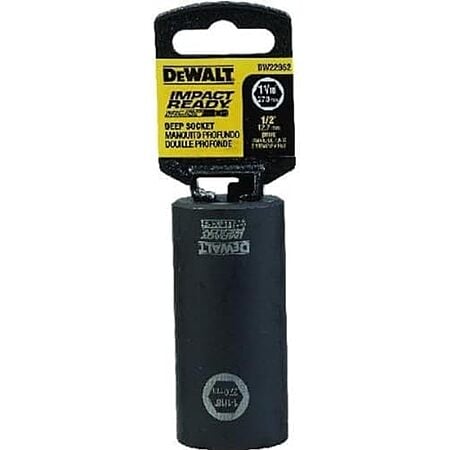
DeWALT 1-1/16" IMPACT READY Deep Socket for 1/2" Drive (DW22952) for
$8.31.
Shipping is free with Prime or on $35+ orders.
Thanks to Deal Hunter
phoinix for sharing this deal.
Product Details:
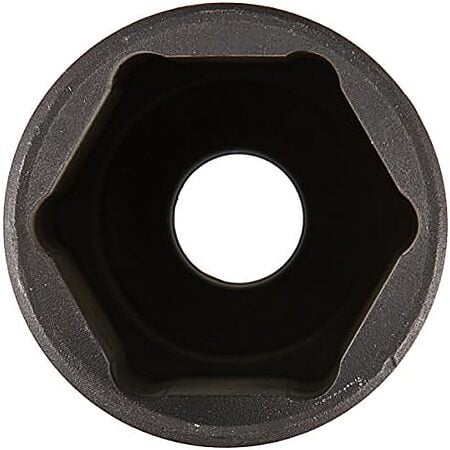
- Recessed corners distributes torque across flats - promoting life
- Thinner than wrench Sockets for tough to access areas
- Large laser etched markings - easily identifiable
- Provides the impact driver user with a socket solution

 Amazon


Top Comments
Join The Conversation
Share your experience with the Slickdeals community
Share information with the community. Please follow our Community Guidelines and be kind!
13 Comments
Sign up for a Slickdeals account to remove this ad.
Our community has rated this post as helpful. If you agree, why not thank psychojinx
" this is preferred because the regular length (non-deep) socket generates more lateral torque on the bolt head than the deep socket ones do"
Regardless, I always recommend using an impact wrench on anode rods to avoid applying force to the pipes. A ratchet (good luck) or breaker bar tends to want to spin the tank because the linear force is distant from the point of rotation. Enough leverage to break the rod free is often enough to overcome the inertia of the tank, even when full. Those rods can be super tight! When I install a water heater for someone, I break the rod free and retighten it sensibly.
" this is preferred because the regular length (non-deep) socket generates more lateral torque on the bolt head than the deep socket ones do"
Regardless, I always recommend using an impact wrench on anode rods to avoid applying force to the pipes. A ratchet (good luck) or breaker bar tends to want to spin the tank because the linear force is distant from the point of rotation. Enough leverage to break the rod free is often enough to overcome the inertia of the tank, even when full. Those rods can be super tight! When I install a water heater for someone, I break the rod free and retighten it sensibly.
Here's the proof why you are wrong. Read it all. You will get a lesson in Physics today:
Q. Wouldn't it be easier (less force needed) to use a normal socket versus a deep socket on an anode rod since the normal socket is lesser in height?
A. Strictly from a physics and stability standpoint, yes, a shallow (normal) socket is better than a deep socket for high-torque jobs like removing a seized anode rod.
Here is why "shorter is better" when things are stuck:
1. Reducing the "Moment Arm" (Tipping Force)
When you use a deep socket, you are moving the ratchet handle further away from the base of the bolt. Even if you try to pull perfectly straight, you inevitably apply a tiny bit of upward or downward force.
- Deep Socket: Acts like a mini-lever that wants to tilt the socket off the bolt. This is called "side-loading," and it's the primary cause of rounded bolt heads.
- Shallow Socket: Keeps the force of the ratchet handle as close to the threads as possible, making the connection much more stable.
2. Minimizing Torsional FlexBelieve it or not, steel twists. When you apply 100+ lbs of force to a long tool setup, the metal actually "winds up" like a very stiff spring before it starts turning the bolt.
Here's the proof why you are wrong. Read it all. You will get a lesson in Physics today:
Q. Wouldn't it be easier (less force needed) to use a normal socket versus a deep socket on an anode rod since the normal socket is lesser in height?
A. Strictly from a physics and stability standpoint, yes, a shallow (normal) socket is better than a deep socket for high-torque jobs like removing a seized anode rod.
Here is why "shorter is better" when things are stuck:
1. Reducing the "Moment Arm" (Tipping Force)
When you use a deep socket, you are moving the ratchet handle further away from the base of the bolt. Even if you try to pull perfectly straight, you inevitably apply a tiny bit of upward or downward force.
- Deep Socket: Acts like a mini-lever that wants to tilt the socket off the bolt. This is called "side-loading," and it's the primary cause of rounded bolt heads.
- Shallow Socket: Keeps the force of the ratchet handle as close to the threads as possible, making the connection much more stable.
2. Minimizing Torsional FlexBelieve it or not, steel twists. When you apply 100+ lbs of force to a long tool setup, the metal actually "winds up" like a very stiff spring before it starts turning the bolt.
Torque=Force x Distance x sin(θ)
sin(90)=1
The point about torsional flex is hooey. Though it takes work to flex (load) the socket in the first place, so long as the socket has not been subjected to forces beyond the material's elastic limit, that work is efficient (unloaded) once the fastener breaks free. (Minus what is lost to heat.) Assuming a continuously applied force.
In the real world, the only part of this that is germane is whether the socket is square on the head or not, which I'll concede is slightly more assured by a shallow socket. Though much less pronounced than say a deep socket on a 1/4" bolt head. I'll skip Claude as my physics professor.
Sign up for a Slickdeals account to remove this ad.
Here's the proof why you are wrong. Read it all. You will get a lesson in Physics today:
Q. Wouldn't it be easier (less force needed) to use a normal socket versus a deep socket on an anode rod since the normal socket is lesser in height?
A. Strictly from a physics and stability standpoint, yes, a shallow (normal) socket is better than a deep socket for high-torque jobs like removing a seized anode rod.
Here is why "shorter is better" when things are stuck:
1. Reducing the "Moment Arm" (Tipping Force)
When you use a deep socket, you are moving the ratchet handle further away from the base of the bolt. Even if you try to pull perfectly straight, you inevitably apply a tiny bit of upward or downward force.
- Deep Socket: Acts like a mini-lever that wants to tilt the socket off the bolt. This is called "side-loading," and it's the primary cause of rounded bolt heads.
- Shallow Socket: Keeps the force of the ratchet handle as close to the threads as possible, making the connection much more stable.
2. Minimizing Torsional FlexBelieve it or not, steel twists. When you apply 100+ lbs of force to a long tool setup, the metal actually "winds up" like a very stiff spring before it starts turning the bolt.
Physics dictates heavy deep impact sockets if clearance permits.
https://www.youtube.com/watch?v=qVd8Bx6
https://www.youtube.com/watch?v=AF6KOE9
Join The Conversation
Share your experience with the Slickdeals community
Share information with the community. Please follow our Community Guidelines and be kind!