Slickdeals is community-supported.  We may get paid by brands for deals, including promoted items.
frontpagephoinix | Staff posted Mar 05, 2026 09:47 AM

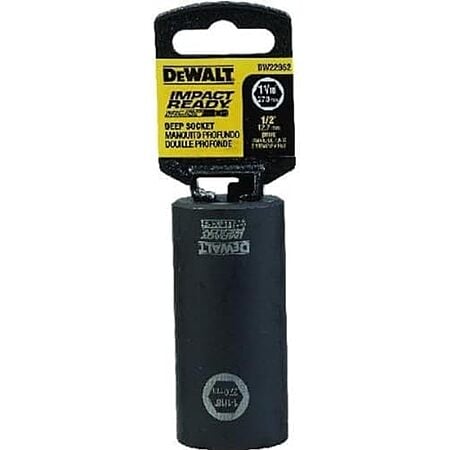
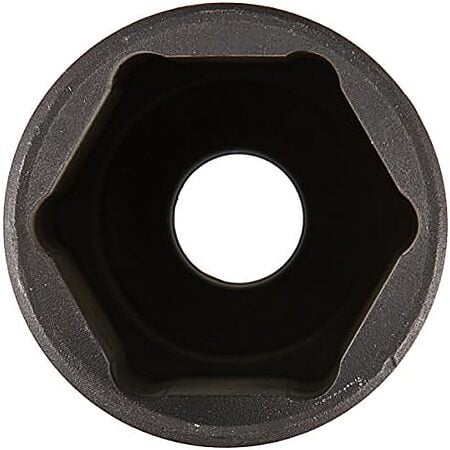
DeWALT 1-1/16" IMPACT READY Deep Socket for 1/2" Drive (DW22952)

$8.30

$19

56% off
Amazon
13 Comments 5,612 Views
Get Deal at Amazon
Good Deal
Save
Share
Deal Details
Amazon has DeWALT 1-1/16" IMPACT READY Deep Socket for 1/2" Drive (DW22952) for $8.31. Shipping is free with Prime or on $35+ orders.

Thanks to Deal Hunter phoinix for sharing this deal.

Product Details:
  • Recessed corners distributes torque across flats - promoting life
  • Thinner than wrench Sockets for tough to access areas
  • Large laser etched markings - easily identifiable
  • Provides the impact driver user with a socket solution

Editor's Notes

Written by Neo45 | Staff
  • About this Deal:
    • Our research indicates that this deal is $5.39 less (39% savings) than the next best available price from a reputable merchant with prices starting at $13.70 at the time of this posting.
    • This deal matches the previous Frontpage Deal.
  • About this Product:
    • Rated 4.8 out of 5 stars at Amazon based on over 1,700 customer reviews.
  • About this Store:
  • Additional Notes:
    • Please see the original post for additional details & give the WIKI and additional forum comments a read for helpful discussion.

Original Post

Written by phoinix | Staff
Product Info
Community Notes
About the Poster
Deal Details
Product Info
Community Notes
About the Poster
Amazon has DeWALT 1-1/16" IMPACT READY Deep Socket for 1/2" Drive (DW22952) for $8.31. Shipping is free with Prime or on $35+ orders.

Thanks to Deal Hunter phoinix for sharing this deal.

Product Details:
  • Recessed corners distributes torque across flats - promoting life
  • Thinner than wrench Sockets for tough to access areas
  • Large laser etched markings - easily identifiable
  • Provides the impact driver user with a socket solution

Editor's Notes

Written by Neo45 | Staff
  • About this Deal:
    • Our research indicates that this deal is $5.39 less (39% savings) than the next best available price from a reputable merchant with prices starting at $13.70 at the time of this posting.
    • This deal matches the previous Frontpage Deal.
  • About this Product:
    • Rated 4.8 out of 5 stars at Amazon based on over 1,700 customer reviews.
  • About this Store:
  • Additional Notes:
    • Please see the original post for additional details & give the WIKI and additional forum comments a read for helpful discussion.

Original Post

Written by phoinix | Staff

Community Voting

Deal Score
+22
Good Deal
Get Deal at Amazon

Price Intelligence

Model: IMPACT READY(R) 1-1/16" 1/2" Drive 6pt Deep Socket

Deal History 

Sale Price
Slickdeal
  • $NaN
  • Today

Leave a Comment

Unregistered (You)

Top Comments

dealaddict101
141 Posts
219 Reputation
Great price for a socket to change out the anode rod

13 Comments

Sign up for a Slickdeals account to remove this ad.

Mar 05, 2026 11:57 AM
141 Posts
Joined Jan 2014
dealaddict101Mar 05, 2026 11:57 AM
141 Posts
Great price for a socket to change out the anode rod
Pro
Mar 05, 2026 02:40 PM
2,338 Posts
Joined Jan 2007
psychojinx
Pro
Mar 05, 2026 02:40 PM
2,338 Posts
this is the exact size you need to change out a water heater anode rod. by the way, don't need a deep socket format to do it no matter what the heater is. people say you do but they are 100% wrong. a regular length 1 1/16 socket will have more than enough clearance to both stick up out of the recess of the anode rod after engaging the head and also enough depth to fully seat the ratchets drive in the socket without the head of the anode rod obstructing it at all. and this is preferred because the regular length (non-deep) socket generates more lateral torque on the bolt head than the deep socket ones do. so that means less of a chance you will need a breaker bar to be involved. i know this all from first hand experience. ace hardware sells a very nice and high quality 1 1/16" DeWalt socket of the shorter regular (non-deep) type for 1/2" drive rachets for only $7.59 (this is the very one I own and use on anode rods), so that's even cheaper than this deal. if you have a 3/8" drive rachet, you need to get a 3/8" to 1/2" drive socket adapter to use these 1/2" sockets. ace also has one of those by DeWalt for $7.99.
Last edited by psychojinx March 5, 2026 at 06:45 AM.
1
1
Mar 05, 2026 03:36 PM
575 Posts
Joined Jul 2012
im14abeerMar 05, 2026 03:36 PM
575 Posts
You're right that standard depth sockets work on anode rods, but this part is hooey
" this is preferred because the regular length (non-deep) socket generates more lateral torque on the bolt head than the deep socket ones do"
Regardless, I always recommend using an impact wrench on anode rods to avoid applying force to the pipes. A ratchet (good luck) or breaker bar tends to want to spin the tank because the linear force is distant from the point of rotation. Enough leverage to break the rod free is often enough to overcome the inertia of the tank, even when full. Those rods can be super tight! When I install a water heater for someone, I break the rod free and retighten it sensibly.
1
2
Pro
Mar 05, 2026 04:08 PM
2,338 Posts
Joined Jan 2007
psychojinx
Pro
Mar 05, 2026 04:08 PM
2,338 Posts
Quote from im14abeer :
You're right that standard depth sockets work on anode rods, but this part is hooey
" this is preferred because the regular length (non-deep) socket generates more lateral torque on the bolt head than the deep socket ones do"
Regardless, I always recommend using an impact wrench on anode rods to avoid applying force to the pipes. A ratchet (good luck) or breaker bar tends to want to spin the tank because the linear force is distant from the point of rotation. Enough leverage to break the rod free is often enough to overcome the inertia of the tank, even when full. Those rods can be super tight! When I install a water heater for someone, I break the rod free and retighten it sensibly.
You are very wrong about the part of my post you called hooey.
Here's the proof why you are wrong. Read it all. You will get a lesson in Physics today:
Q. Wouldn't it be easier (less force needed) to use a normal socket versus a deep socket on an anode rod since the normal socket is lesser in height?
A. Strictly from a physics and stability standpoint, yes, a shallow (normal) socket is better than a deep socket for high-torque jobs like removing a seized anode rod.
​Here is why "shorter is better" when things are stuck:
​1. Reducing the "Moment Arm" (Tipping Force)

​When you use a deep socket, you are moving the ratchet handle further away from the base of the bolt. Even if you try to pull perfectly straight, you inevitably apply a tiny bit of upward or downward force.
  • Deep Socket: Acts like a mini-lever that wants to tilt the socket off the bolt. This is called "side-loading," and it's the primary cause of rounded bolt heads.
  • Shallow Socket: Keeps the force of the ratchet handle as close to the threads as possible, making the connection much more stable.
​2. Minimizing Torsional Flex

​Believe it or not, steel twists. When you apply 100+ lbs of force to a long tool setup, the metal actually "winds up" like a very stiff spring before it starts turning the bolt.
  • ​A deep socket has more metal to twist than a shallow one.
  • ​By using a shallow socket, more of your physical energy goes directly into turning the rod rather than stretching the tool.
1
2
Mar 05, 2026 06:01 PM
575 Posts
Joined Jul 2012
im14abeerMar 05, 2026 06:01 PM
575 Posts
Quote from psychojinx :
You are very wrong about the part of my post you called hooey.
Here's the proof why you are wrong. Read it all. You will get a lesson in Physics today:
Q. Wouldn't it be easier (less force needed) to use a normal socket versus a deep socket on an anode rod since the normal socket is lesser in height?
A. Strictly from a physics and stability standpoint, yes, a shallow (normal) socket is better than a deep socket for high-torque jobs like removing a seized anode rod.
​Here is why "shorter is better" when things are stuck:
​1. Reducing the "Moment Arm" (Tipping Force)

​When you use a deep socket, you are moving the ratchet handle further away from the base of the bolt. Even if you try to pull perfectly straight, you inevitably apply a tiny bit of upward or downward force.


  • Deep Socket: Acts like a mini-lever that wants to tilt the socket off the bolt. This is called "side-loading," and it's the primary cause of rounded bolt heads.
  • Shallow Socket: Keeps the force of the ratchet handle as close to the threads as possible, making the connection much more stable.
​2. Minimizing Torsional Flex

​Believe it or not, steel twists. When you apply 100+ lbs of force to a long tool setup, the metal actually "winds up" like a very stiff spring before it starts turning the bolt.


  • ​A deep socket has more metal to twist than a shallow one.
  • ​By using a shallow socket, more of your physical energy goes directly into turning the rod rather than stretching the tool.
Perhaps I'm being pendantic, but tipping force and moment arm are not synonyms. The moment arm is the perpendicular distance from the point of rotation. In a rigid assembly, changing the angle of the socket does not alter the amount of force applied, it alters its vector. This is a practical matter, the physics don't change. I'm going to call this a skill issue. Especially when using a breaker bar. The actual angle of the moment arm is much more likely to be a factor since breaker bars have pivots in them. Changing that angle actually does alter the force applied since it takes the moment arm from the perpendicular plane.
Torque=Force x Distance x sin(θ)
sin(90)=1

The point about torsional flex is hooey. Though it takes work to flex (load) the socket in the first place, so long as the socket has not been subjected to forces beyond the material's elastic limit, that work is efficient (unloaded) once the fastener breaks free. (Minus what is lost to heat.) Assuming a continuously applied force.

In the real world, the only part of this that is germane is whether the socket is square on the head or not, which I'll concede is slightly more assured by a shallow socket. Though much less pronounced than say a deep socket on a 1/4" bolt head. I'll skip Claude as my physics professor.
Last edited by im14abeer March 5, 2026 at 10:43 AM.
2
Today 10:58 AM
188 Posts
Joined Dec 2012
blautensToday 10:58 AM
188 Posts
Came here for a bargain impact socket. Staying for Physics UFC.
4
Today 11:14 AM
66 Posts
Joined Nov 2025
alecmed8292Today 11:14 AM
66 Posts
Great deal

Sign up for a Slickdeals account to remove this ad.

Today 12:10 PM
204 Posts
Joined Apr 2008
bpollardToday 12:10 PM
204 Posts
Quote from dealaddict101 :
Great price for a socket to change out the anode rod
came here to say this. (also 27mm I believe).
Last edited by bpollard March 9, 2026 at 05:17 AM.
Pro
Today 12:38 PM
3,065 Posts
Joined Sep 2011
E4300
Pro
Today 12:38 PM
3,065 Posts
Quote from psychojinx :
You are very wrong about the part of my post you called hooey.
Here's the proof why you are wrong. Read it all. You will get a lesson in Physics today:
Q. Wouldn't it be easier (less force needed) to use a normal socket versus a deep socket on an anode rod since the normal socket is lesser in height?
A. Strictly from a physics and stability standpoint, yes, a shallow (normal) socket is better than a deep socket for high-torque jobs like removing a seized anode rod.
​Here is why "shorter is better" when things are stuck:
​1. Reducing the "Moment Arm" (Tipping Force)

​When you use a deep socket, you are moving the ratchet handle further away from the base of the bolt. Even if you try to pull perfectly straight, you inevitably apply a tiny bit of upward or downward force.
  • Deep Socket: Acts like a mini-lever that wants to tilt the socket off the bolt. This is called "side-loading," and it's the primary cause of rounded bolt heads.
  • Shallow Socket: Keeps the force of the ratchet handle as close to the threads as possible, making the connection much more stable.
​2. Minimizing Torsional Flex

​Believe it or not, steel twists. When you apply 100+ lbs of force to a long tool setup, the metal actually "winds up" like a very stiff spring before it starts turning the bolt.
  • ​A deep socket has more metal to twist than a shallow one.
  • ​By using a shallow socket, more of your physical energy goes directly into turning the rod rather than stretching the tool.
A heavier impact socket will provide more torque (kinetic energy = 1/2 mass x velocity x velocity). Draw a free body diagram of the bolt. The point of contact at the bolt should be the same with the shallow and deep socket. Therefore, a deep impact socket that's off axis by 10 degree isn't going to round off the bolt due to the miniscule increase in "side-loading" force. Big construction equipment requires deep impact sockets and 1" impact wrench with long anvil that can generate +1000 ft-lb torque.

Physics dictates heavy deep impact sockets if clearance permits.

https://www.youtube.com/watch?v=qVd8Bx6AAQc

https://www.youtube.com/watch?v=AF6KOE9VCQc
Today 01:40 PM
527 Posts
Joined Jan 2008
CheesecycleToday 01:40 PM
527 Posts
Quote from bpollard :
came here to say this. (also 27mm I believe).
Yep, 27mm works too. I used one a few weeks ago on my anode rod.
Today 01:44 PM
30 Posts
Joined Feb 2018
iceterranToday 01:44 PM
30 Posts
solid quality and price
Today 02:19 PM
1,133 Posts
Joined Mar 2010
gr8scottazToday 02:19 PM
1,133 Posts
Quote from blautens :
Came here for a bargain impact socket. Staying for Physics UFC.
Agreed. I got some popcorn and was hoping for more.
Today 03:02 PM
1,444 Posts
Joined Jun 2007
BrentDToday 03:02 PM
1,444 Posts
Quote from psychojinx :
this is the exact size you need to change out a water heater anode rod. by the way, don't need a deep socket format to do it no matter what the heater is.
Ehhh, counterpoint... RV water heaters. With where RV water heaters are installed and recessed inside of a panel typically, the deep socket is much less of a hassle and less likely to have you wind up with bloody knuckles. Sure you can just put an extension on a standard socket, but that's one less thing to have to dig through the toolbox to find. And I typically just leave this socket in the camper so I don't have to track it down, and in case it needs to be done when I'm not near my garage.
1

Leave a Comment

Unregistered (You)

Popular Deals

Trending Deals