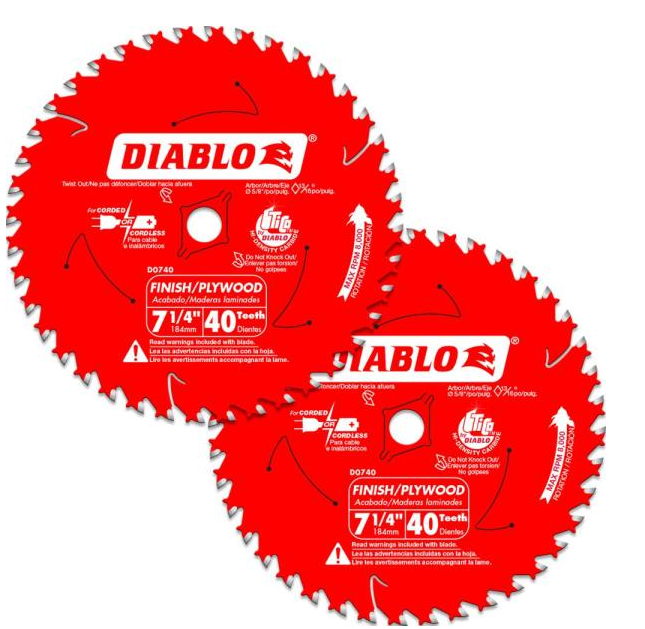
DIABLO 7-1/4 in. 40-Tooth Finish Circular Saw Blade Value Pack (2-Pack) $9.88 YMMV B&M
$9.88
$19.88
+21Deal Score
8,203 Views
Hello there
Home Depot is clearancing out the Diablo 40 tooth 7-1/4 blades. Retail $19.88 but now $9.88 for 2 packs. Says out of stock online. But in stores, it's on clearance.
Here is a Brickseek link, Search your region for store quantity availability: https://brickseek.com/home-depot-inventory-checker/?sku=312091965[brickseek.com]
Blades get cheap but the lumber to cut to cut doubles in price. Nice blades thanks op
That's because there is no longer a need for saw blades. We use the lumber in whole pieces only because we don't want to throw any of the expensive wood away!
Our community has rated this post as helpful. If you agree, why not thank jd45123
12-13-2020 at 08:52 AM.
Note: These are some comments I made previously on using 7 1/4" blades in a 10" table saw:
------------------------------------------------------------------------------------------
This is the preferred blade for a 10" saw (in fact, I have this exact blade in my saw right now and just picked up two more here) for most people for the following reasons:
1) Blade is cheaper
2) Blade gives a thinner cut
3) Blade cuts down wear and tear on motor
4) Blade cuts down chance of kickback by 93 -96% (see below for calc) so it is a lot safer.
5) Blade just feels easier and safer to use than a 10"
6) Blade will handle most peoples cuts (will cut about 3 1/2" when do the flip)
Note, if you need to cut deeper than 3 1/2" you will need to change over to a 10" blade. I would estimate 95% of my cuts (and I'm guessing most people's) are 3 1/2 " or less. I rarely need to change in my 10" blade (and it only take a few minutes to switch it when I need it).
-------
Calculation
A spinning wheel rotating around its symmetry axis. Energy is stored as kinetic energy, more specifically rotational energy of the rotor
Kinetic energy = Ek=1/2 I w^{2}
I=is the moment of inertia of the wheel about its axis of symmetry and is a measure of resistance to torque applied on a spinning object. For a thin-walled empty cylinder I=mr^{2}
w = the angular velocity
Mass of circle = pi * r^{2} the 10" is twice as thick of the 7.25" so mass is:
7.25 = 41
10 = 158 (79 * 2)
Circumference of circle = pi * d
7.25 = 22.8
10 = 31.4
Therefore at the same rpm, the 10" is spinning 38% faster at edge of blade, or
w 7.25 = 1 and w 10" = 1.38
Therefore, the kinetic energy of a 7.25" blade is 7% of a 10" blade or 93% less!
With 93% less kinetic energy, the energy to create kickbacks is just not there (and since the riving knife is probably removed it is even safer than a 10" w/o a riving knife.
I don't bother to use a riving knife when I use a 7.25" blade, but put it on when I use my 10" blade (which is maybe 5% of the time I use the saw)
UPDATE:
if 10" blade is 2.5 as thick as 7.25", kinetic energy would be 4653.87 if blade is 3.0 thicker, kinetic energy would be 5641.78
Therefore reduction in energy
2.0 = 92.8%
2.5 = 94.2%
3.0 = 95.7%
Note: These are some comments I made previously on using 7 1/4" blades in a 10" table saw:
------------------------------------------------------------------------------------------
This is the preferred blade for a 10" saw (in fact, I have this exact blade in my saw right now and just picked up two more here) for most people for the following reasons:
1) Blade is cheaper
2) Blade gives a thinner cut
3) Blade cuts down wear and tear on motor
4) Blade cuts down chance of kickback by 93 -96% (see below for calc) so it is a lot safer.
5) Blade just feels easier and safer to use than a 10"
6) Blade will handle most peoples cuts (will cut about 3 1/2" when do the flip)
Note, if you need to cut deeper than 3 1/2" you will need to change over to a 10" blade. I would estimate 95% of my cuts (and I'm guessing most people's) are 3 1/2 " or less. I rarely need to change in my 10" blade (and it only take a few minutes to switch it when I need it).
-------
Calculation
A spinning wheel rotating around its symmetry axis. Energy is stored as kinetic energy, more specifically rotational energy of the rotor
Kinetic energy = Ek=1/2 I w^{2}
I=is the moment of inertia of the wheel about its axis of symmetry and is a measure of resistance to torque applied on a spinning object. For a thin-walled empty cylinder I=mr^{2}
w = the angular velocity
Mass of circle = pi * r^{2} the 10" is twice as thick of the 7.25" so mass is:
7.25 = 41
10 = 158 (79 * 2)
Circumference of circle = pi * d
7.25 = 22.8
10 = 31.4
Therefore at the same rpm, the 10" is spinning 38% faster at edge of blade, or
w 7.25 = 1 and w 10" = 1.38
Therefore, the kinetic energy of a 7.25" blade is 7% of a 10" blade or 93% less!
With 93% less kinetic energy, the energy to create kickbacks is just not there (and since the riving knife is probably removed it is even safer than a 10" w/o a riving knife.
I don't bother to use a riving knife when I use a 7.25" blade, but put it on when I use my 10" blade (which is maybe 5% of the time I use the saw)
UPDATE:
if 10" blade is 2.5 as thick as 7.25", kinetic energy would be 4653.87 if blade is 3.0 thicker, kinetic energy would be 5641.78
Therefore reduction in energy
2.0 = 92.8%
2.5 = 94.2%
3.0 = 95.7%
Assuming a saw blade is "a thin-walled empty cylinder," which it is not.
We use larger powered saws and saw blades because the larger circumference of the blade has proportionately more teeth cutting whatever at the same RPM's.... which equates to faster cutting that being larger,of course has more kinetic energy that we want.... and why we don't use a Dremel for ripping boards.
Kickback is almost always operator error.... we have all done it and why we teach people to stand to the side of the saw cut line in case there is maybe a hidden nail or a knot, or the board is warped and pinching, etc.
PS: But yes, if on the cheap, these 7-1/4" blades will work on a 8 -1/4, 10" and even some 12" saws with a 5/8" arbor.... and fine for occasional usage or even the inexperienced. After all, there have been plenty of emergency room visits caused by the lowly 6-1/2 and 7-1/4 inch circular saw.
I believe these are the same blades. The displays in the store and the clearance section both had the same blades. No one seemed to have bought them. And now they're better than the black friday deal.


27 Comments
Your comment cannot be blank.
Sign up for a Slickdeals account to remove this ad.
https://slickdeals.net/e/14476385-home-depot-black-friday-diablo-2-pack-7-1-4-40-tooth-finish-saw-blade-for-14-97
https://www.homedepot.c
That's because there is no longer a need for saw blades. We use the lumber in whole pieces only because we don't want to throw any of the expensive wood away!
........... sounds like my first marriage:
wife + murder in-law.
Sign up for a Slickdeals account to remove this ad.
Many cordless saws use 6 1/2" blades, though they are becoming less common in an era of brushless tools.
Our community has rated this post as helpful. If you agree, why not thank jd45123
------------------------------------------------------------------------------------------
This is the preferred blade for a 10" saw (in fact, I have this exact blade in my saw right now and just picked up two more here) for most people for the following reasons:
1) Blade is cheaper
2) Blade gives a thinner cut
3) Blade cuts down wear and tear on motor
4) Blade cuts down chance of kickback by 93 -96% (see below for calc) so it is a lot safer.
5) Blade just feels easier and safer to use than a 10"
6) Blade will handle most peoples cuts (will cut about 3 1/2" when do the flip)
Note, if you need to cut deeper than 3 1/2" you will need to change over to a 10" blade. I would estimate 95% of my cuts (and I'm guessing most people's) are 3 1/2 " or less. I rarely need to change in my 10" blade (and it only take a few minutes to switch it when I need it).
Here is The Master Woodworker explaining it https://www.youtube.com/watch?v=lVO7BkA
-------
Calculation
A spinning wheel rotating around its symmetry axis. Energy is stored as kinetic energy, more specifically rotational energy of the rotor
Kinetic energy = Ek=1/2 I w^{2}
I=is the moment of inertia of the wheel about its axis of symmetry and is a measure of resistance to torque applied on a spinning object. For a thin-walled empty cylinder I=mr^{2}
w = the angular velocity
Mass of circle = pi * r^{2} the 10" is twice as thick of the 7.25" so mass is:
7.25 = 41
10 = 158 (79 * 2)
Circumference of circle = pi * d
7.25 = 22.8
10 = 31.4
Therefore at the same rpm, the 10" is spinning 38% faster at edge of blade, or
w 7.25 = 1 and w 10" = 1.38
I =
7.25 = 41 * 3.625^{2} = 538.7
10 = 158 * 5^{2} = 3950
Therefore, Kinetic Energy =
7.25 = 1/2 * 538.7 * 1^{2} = 269.4
10 = 1/2 * 3950 * 1.38^{2} = 3761.2
Therefore, the kinetic energy of a 7.25" blade is 7% of a 10" blade or 93% less!
With 93% less kinetic energy, the energy to create kickbacks is just not there (and since the riving knife is probably removed it is even safer than a 10" w/o a riving knife.
I don't bother to use a riving knife when I use a 7.25" blade, but put it on when I use my 10" blade (which is maybe 5% of the time I use the saw)
UPDATE:
if 10" blade is 2.5 as thick as 7.25", kinetic energy would be 4653.87 if blade is 3.0 thicker, kinetic energy would be 5641.78
Therefore reduction in energy
2.0 = 92.8%
2.5 = 94.2%
3.0 = 95.7%
------------------------------------------------------------------------------------------
This is the preferred blade for a 10" saw (in fact, I have this exact blade in my saw right now and just picked up two more here) for most people for the following reasons:
1) Blade is cheaper
2) Blade gives a thinner cut
3) Blade cuts down wear and tear on motor
4) Blade cuts down chance of kickback by 93 -96% (see below for calc) so it is a lot safer.
5) Blade just feels easier and safer to use than a 10"
6) Blade will handle most peoples cuts (will cut about 3 1/2" when do the flip)
Note, if you need to cut deeper than 3 1/2" you will need to change over to a 10" blade. I would estimate 95% of my cuts (and I'm guessing most people's) are 3 1/2 " or less. I rarely need to change in my 10" blade (and it only take a few minutes to switch it when I need it).
Here is The Master Woodworker explaining it https://www.youtube.com/watch?v=lVO7BkA
-------
Calculation
A spinning wheel rotating around its symmetry axis. Energy is stored as kinetic energy, more specifically rotational energy of the rotor
Kinetic energy = Ek=1/2 I w^{2}
I=is the moment of inertia of the wheel about its axis of symmetry and is a measure of resistance to torque applied on a spinning object. For a thin-walled empty cylinder I=mr^{2}
w = the angular velocity
Mass of circle = pi * r^{2} the 10" is twice as thick of the 7.25" so mass is:
7.25 = 41
10 = 158 (79 * 2)
Circumference of circle = pi * d
7.25 = 22.8
10 = 31.4
Therefore at the same rpm, the 10" is spinning 38% faster at edge of blade, or
w 7.25 = 1 and w 10" = 1.38
I =
7.25 = 41 * 3.625^{2} = 538.7
10 = 158 * 5^{2} = 3950
Therefore, Kinetic Energy =
7.25 = 1/2 * 538.7 * 1^{2} = 269.4
10 = 1/2 * 3950 * 1.38^{2} = 3761.2
Therefore, the kinetic energy of a 7.25" blade is 7% of a 10" blade or 93% less!
With 93% less kinetic energy, the energy to create kickbacks is just not there (and since the riving knife is probably removed it is even safer than a 10" w/o a riving knife.
I don't bother to use a riving knife when I use a 7.25" blade, but put it on when I use my 10" blade (which is maybe 5% of the time I use the saw)
UPDATE:
if 10" blade is 2.5 as thick as 7.25", kinetic energy would be 4653.87 if blade is 3.0 thicker, kinetic energy would be 5641.78
Therefore reduction in energy
2.0 = 92.8%
2.5 = 94.2%
3.0 = 95.7%
Assuming a saw blade is "a thin-walled empty cylinder," which it is not.
We use larger powered saws and saw blades because the larger circumference of the blade has proportionately more teeth cutting whatever at the same RPM's.... which equates to faster cutting that being larger,of course has more kinetic energy that we want.... and why we don't use a Dremel for ripping boards.
Kickback is almost always operator error.... we have all done it and why we teach people to stand to the side of the saw cut line in case there is maybe a hidden nail or a knot, or the board is warped and pinching, etc.
PS: But yes, if on the cheap, these 7-1/4" blades will work on a 8 -1/4, 10" and even some 12" saws with a 5/8" arbor.... and fine for occasional usage or even the inexperienced. After all, there have been plenty of emergency room visits caused by the lowly 6-1/2 and 7-1/4 inch circular saw.
https://slickdeals.net/e/14476385-home-depot-black-friday-diablo-2-pack-7-1-4-40-tooth-finish-saw-blade-for-14-97
https://www.homedepot.c
I believe these are the same blades. The displays in the store and the clearance section both had the same blades. No one seemed to have bought them. And now they're better than the black friday deal.
https://brickseek.com/home-depot-...=312091965