
Did this coupon
work for you?
work for you?


| Rating: | (4.4 out of 5 stars) |
| Reviews: | 73 Amazon Reviews |
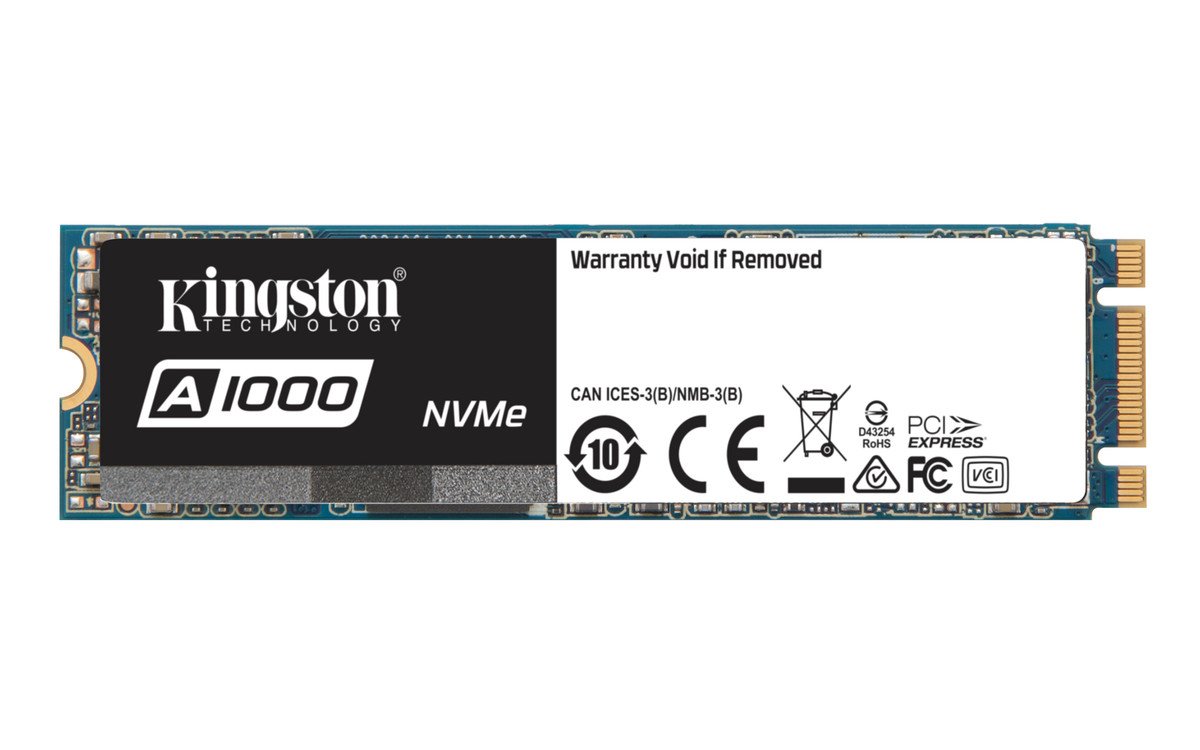
| Product Name: | Kingston Digital SA1000M8/240G A1000 240GB PCIe NVMe M.2 2280 Internal SSD High Performance Solid State Drive |
| Product Description: | Kingston's A1000 solid-state drive is an entry-level PCIe NVMe solution with a single-sided M.2 22x80mm design. This form factor is ideal for thinner notebooks and systems with limited space. Using a PCIe NVMe Gen 3.0 x2 interface, 4-channel Phison E8 controller, and 3D NAND Flash, this drive offers read and write speeds up to 1,500MB/s and 1,000MB/s1‑. It is 2X faster than a SATA-based SSD and 20X faster than a traditional hard drive offering exceptional responsiveness, ultra-low latency, and throughput. More reliable and durable than a hard drive, A1000 is built with NAND Flash semiconductor memory. There are no moving parts, making it far less likely to fail than a mechanical hard drive. It is also cooler and quieter, and its shock and vibration resistance makes it ideal for notebooks and other mobile computing devices. A1000 is available in multiple capacities from 240GB-960GB2 to give you all the space you need for applications, videos, photos, and other important documents. You can also replace your hard drive or a smaller SSD with a drive with enough storage capacity for all your files. |
| Model Number: | SA1000M8/240G |
| Product SKU: | B07BMXS6SH |

The link has been copied to the clipboard.

13 Comments
Your comment cannot be blank.
Sign up for a Slickdeals account to remove this ad.
Get a PCIe adapter and give it a shot!
That said, the advantage of M2 itself is saving space -- why it's popular in thinner laptops. The advantage of NVMe is speed, though unless you're moving loads of data you'll likely not notice the difference in everyday use -- in my experience win10 performs the same installed to a regular SSD, including boot times.
The disadvantages of NVMe are heat, it can be difficult to get working, depending on BIOS, and cloning a working copy of Windows won't work -- have to install fresh or use Migration software tools.
That micron is way slower than this drive. But you get double the storage for a lit bit more. Depends on what you need. I needed mine for a thin client TV box that will be streaming anyway.
Sign up for a Slickdeals account to remove this ad.
This kingston drive is pretty slow
"Sequential read or write speeds up to 1,500 or 900 mb per second"
Sabrent is 3000mbps or 2000mbps
The plus on the kingston is that it is shipped and sold by amazon and is a more well known brand.
If the sabrent deal was also shipped and sold by amazon, I would have bought it.
This kingston drive is pretty slow
"Sequential read or write speeds up to 1,500 or 900 mb per second"
Sabrent is 3000mbps or 2000mbps
The plus on the kingston is that it is shipped and sold by amazon and is a more well known brand.
If the sabrent deal was also shipped and sold by amazon, I would have bought it.
Am I missing something? It's the same return policy. So what difference does it make?
That said, the advantage of M2 itself is saving space -- why it's popular in thinner laptops. The advantage of NVMe is speed, though unless you're moving loads of data you'll likely not notice the difference in everyday use -- in my experience win10 performs the same installed to a regular SSD, including boot times.
The disadvantages of NVMe are heat, it can be difficult to get working, depending on BIOS, and cloning a working copy of Windows won't work -- have to install fresh or use Migration software tools.
Hmm.. I just installed an nvme drive and cloned the (slow) boot SSD that it replaced. It crashed once and booted fine the next and has been working very well. It even took over the drive letter and the other drives kept their drive letter (3 other drives). I probably should make a fresh install at this point since I've changed motherboard, CPU, drives, and RAM.
Cloned using Macrium reflect free.
Increase partition using minitool partition wizard free.
That said, the advantage of M2 itself is saving space -- why it's popular in thinner laptops. The advantage of NVMe is speed, though unless you're moving loads of data you'll likely not notice the difference in everyday use -- in my experience win10 performs the same installed to a regular SSD, including boot times.
The disadvantages of NVMe are heat, it can be difficult to get working, depending on BIOS, and cloning a working copy of Windows won't work -- have to install fresh or use Migration software tools.
What issues did you have? I've cloned windows 10 boot partition onto an NVME drive three times without any difficulty. I used Macrium Reflect.